
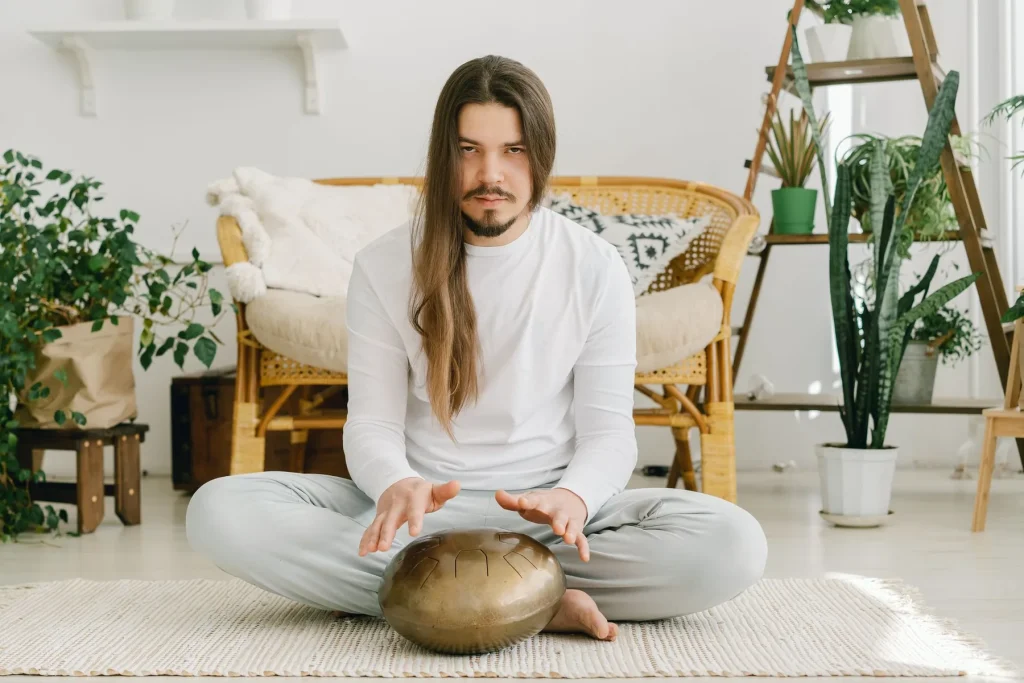
The handpan is a unique melodic percussion instrument, often compared to a flying saucer because of its shape. Since it appeared in the early 2000s, it has captivated musicians with its deep, soothing tones. This instrument combines rhythms, melodies, and harmonics, offering exceptional sonic versatility.
To unlock the handpan’s full potential, it is essential to master certain basic techniques. These include practicing simple scales and basic rhythms, as well as exploring repeating patterns. These practices help develop a keen musical ear and a feel for the depth of the sounds produced.
Improvisation plays a key role in musical expression with this instrument. It allows you to unleash your creativity and connect with the present moment. Whether you are a beginner or an experienced player, this guide will support your progress by covering a variety of topics, such as advanced techniques and the integration of different musical styles.
Learn how to improvise on a handpan and explore the benefits of this instrument for personal expression and public performance.
Introduction to the handpan and improvisation
With its melodic notes, the handpan has become a favored tool for self-expression. This instrument, made from two hammered-steel shells, offers 8 to 12 tuned notes. Its unique shape and deep tones make it an ideal companion for musicians seeking creativity.
What is a handpan?
Inspired by the Trinidadian steelpan and the Indian ghatam, the handpan is a modern instrument. Each note is tuned to a specific scale, often D minor, creating natural harmony. It is generally played on the lap or on a dedicated stand, providing a comfortable position from which to explore its sounds.
Sound-production techniques include finger strikes, palm strokes, and the use of harmonics. These methods make it possible to vary textures and nuances, making every performance unique.
Why is improvisation essential?
Improvisation lies at the heart of handpan playing. It enables you to respond to the emotions of the moment, create spontaneous melodies, and establish a musical dialogue. According to Thierry Bleton, “the handpan is an instrument that naturally invites free and intuitive expression.”
One study reveals that 78% of players improvise daily. This approach fosters a deep connection with the instrument and unleashes creativity. To learn more about techniques for playing the handpan well, explore our dedicated resources.
The basics of handpan improvisation
Exploring the basics of improvisation helps unleash your musical creativity. To do so, it is essential to understand notes and scales and to master fundamental striking techniques. These elements form the foundation of fluid, expressive playing.
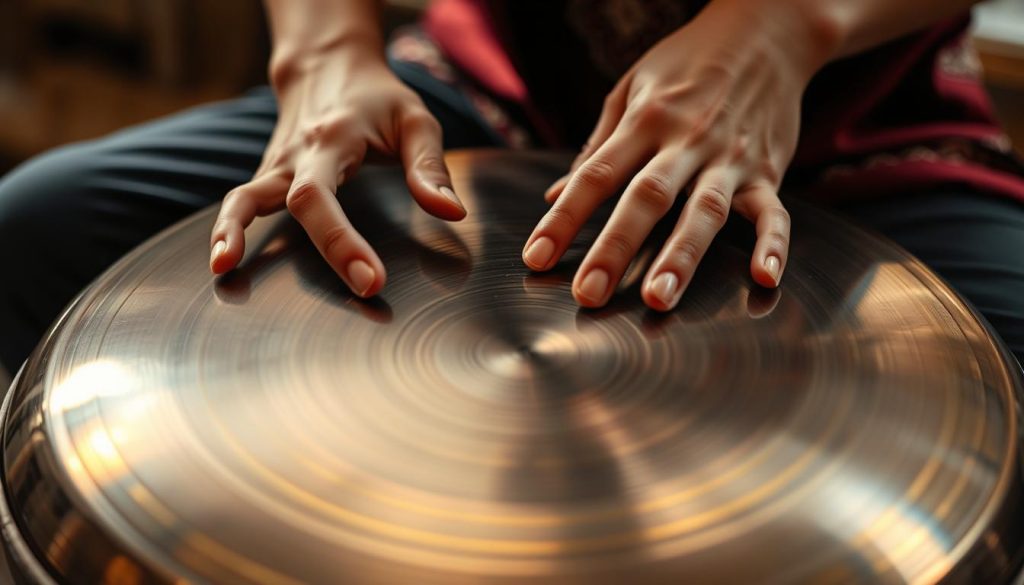
Understanding notes and scales
The handpan is often tuned to D minor, a scale that offers natural harmony. The central and surrounding notes can be used to create rich and varied melodies. For beginners, a visual notation system with color coding can make learning easier.
An effective exercise is the “Butterfly,” which consists of alternating the left and right hands on the central notes. This helps develop coordination and a better feel for intervals.
Fundamental striking techniques
The way you strike the notes greatly influences their resonance and the emotion conveyed. Use your fingertips for high notes, with about 30% force, and your palm for low notes, with 70% force. This produces an optimal tonal balance.
An ergonomic position at a 45° angle promotes maximum resonance. Avoid stiff wrists to preserve the fluidity of your playing.
| Element | Description | Tip |
|---|---|---|
| Central notes | Fundamental to melodies | Practice the “Butterfly” exercise |
| Finger strike | Using the fingertips | 30% force for high notes |
| Position | 45° angle | Avoid stiff wrists |
To develop your techniques further, consult this guide to mastering advanced techniques. It will help you refine your approach and explore new musical possibilities.
How to develop your musical ear
Good musical listening transforms the way you play. To progress, it is essential to train your ear. This helps you better understand melodies, rhythms, and sonic nuances.
Listen to and reproduce melodies
Active listening is the first step. Analyze pieces by masters such as David Charrier or Daniel Waples. Try to reproduce their melodies using the “shadow playing” technique, which consists of immediately imitating what you hear.
Use apps such as Soundbrenner to train your ear. These tools help you recognize intervals and improve your accuracy.
Exercises to improve your listening
Practice an interval exercise: identify thirds and fifths by ear. This strengthens your ability to recognize notes quickly.
The “Echo Game” method is also effective. Play a musical phrase and ask a partner to repeat it. This develops active listening and responsiveness.
Record your sessions with a metronome set to 60 BPM. This allows you to analyze your rhythm and improve through regular self-assessment.
| Exercise | Objective | Tip |
|---|---|---|
| Shadow Playing | Reproduce musical phrases | Start with simple pieces |
| Interval exercise | Recognize thirds and fifths | Practice daily |
| Echo Game | Improve active listening | Work with a partner |
| Recording | Self-assess rhythm | Use a metronome |
These exercises will help you develop a keen musical ear. They will enrich your experience and allow you to play with greater fluidity and creativity.
Advanced handpan improvisation techniques
To go even further, discover innovative methods. These techniques will allow you to explore new sonic dimensions and unleash your creativity. Whether you use harmonics or explore complex rhythms, each step enriches your playing.
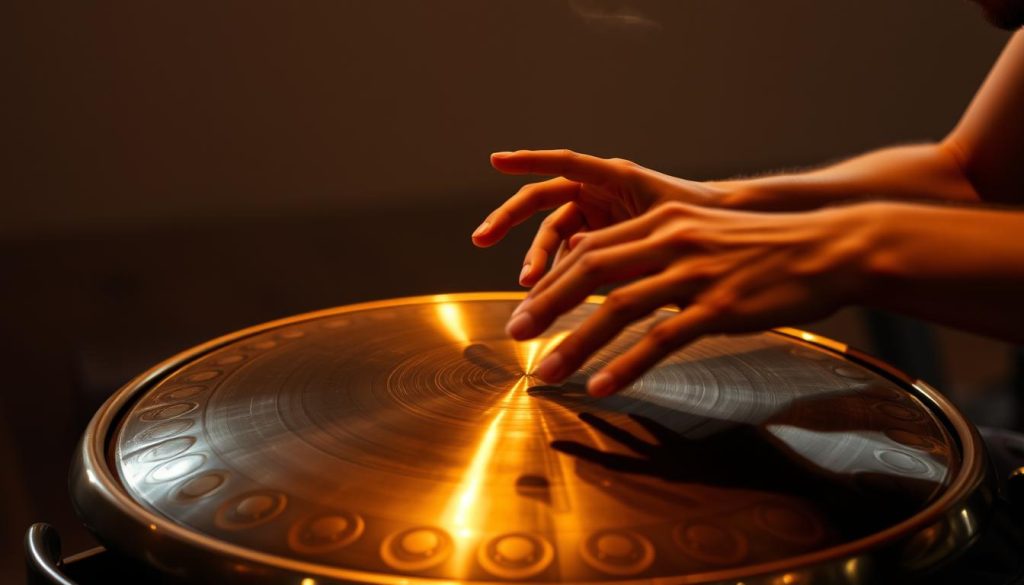
Using harmonics and slides
Harmonics add unique depth to your music. To bring them out, adjust your finger attack to suit the note. A light strike on the edges of the handpan produces rich, resonant sounds.
The “water ripple” technique is ideal for glissandos. By sliding your fingers across the notes, you create smooth, melodic transitions. This method requires precision, but it turns your playing into an immersive experience.
Exploring complex rhythms
Complex rhythms, such as 5/8 and 7/8 meters, add unique energy. Practice polyrhythmic exercises, such as alternating between the left and right hands. This develops your coordination and sense of tempo.
The “Spider Walk” method is effective for moving quickly. It consists of linking notes smoothly while using rests as rhythmic elements. These strategic pauses strengthen the impact of your music.
| Technique | Application | Tip |
|---|---|---|
| Harmonics | Add depth | Strike the edges lightly |
| Water Ripple | Create glissandos | Work on precision |
| Polyrhythms | Add energy to your playing | Alternate the left and right hands |
| Spider Walk | Move quickly | Use rests strategically |
These techniques will transform your musical approach. For a visual demonstration, consult our video tutorial on circular slides. It will help you master these methods and expand your repertoire.
How to create unique melodies
Creating unique melodies on the handpan requires a structured yet intuitive approach. By combining proven techniques with attentive listening, you can develop personal and expressive playing.
Structuring your improvisations
The ABA form is an excellent starting point. It consists of introducing a musical idea (A), developing it (B), and then returning to it (A). This structure brings coherence to your creations.
The “call and response” technique is also effective. Use a loop recorder to play a phrase, then answer it with a variation. This expands your repertoire and stimulates your creativity.
Using silence and pauses
Silences are as important as notes. They create a contrast and add depth to your music. Practice exercises in which you incorporate strategic pauses to mark the beat.
The “Storytelling” method consists of associating emotions with musical patterns. For example, a prolonged silence can evoke anticipation or reflection, while a rapid phrase can express joy.
- Limitation exercise: play using only three notes to explore all their possibilities.
- Rhythmic pedals: use them to create harmonic layers and enrich your playing.
- Body and breathing: incorporate movement and synchronized breathing for more natural expression.
Finally, live improvisation with real-time processing offers an immersive experience. It allows you to respond instantly to the sounds produced and create spontaneous melodies.
Playing with other instruments
Combining the handpan with other instruments opens up new musical horizons. This collaboration enriches your experience and makes it possible to create more complex and harmonious compositions. Whether in a group or a duo, integrating the handpan requires active listening and constant adaptation.
Integrating the handpan into a group
To fit well into a group, start by setting your instrument’s tuning to 432 Hz. This frequency promotes compatibility with other instruments. Position yourself at a 120° angle to the percussionists for optimal sonic balance.
Use contact microphones for natural amplification. This preserves the handpan’s sonic nuances while integrating it seamlessly into the overall mix. Practice active-listening exercises during jam sessions to interact more effectively with the other musicians.
Harmonizing with other sounds
Harmonizing with other sounds requires control of frequencies. For example, you can use an acoustic guitar to create complementary melodic layers. Work on pieces combining the udu and shruti box to explore varied sonic textures.
During rehearsals, establish a set of nonverbal communication cues. This facilitates exchanges among the musicians and improves group cohesion. These practices will help you create rich, balanced compositions.
Tips for making rapid progress
Making rapid progress on the handpan requires a methodical and structured approach. By combining proven techniques with regular analysis, you can accelerate your learning and achieve your musical goals more effectively.

Practice regularly
The key to success is regular practice. Adopt the 30/30/30 protocol: 30 minutes of technique, 30 minutes of improvisation, and 30 minutes of repertoire work. This balanced method allows you to develop a variety of skills while maintaining your motivation.
The “slow motion playing” technique is particularly effective for improving accuracy. By slowing down your movements, you can spot mistakes and refine your playing. Use apps such as MasterTheHandpan to track your progress and adapt your practice.
Record and analyze your performances
Recording your sessions is a powerful learning tool. Analyze your performances using spectral analysis, which reveals sonic nuances and areas for improvement. This approach helps you identify your strengths and work on your weaknesses.
Join local and online communities to exchange feedback and advice. Testimonials from students who have taken David Charrier’s course show that this method promotes rapid progress and better quality of playing.
| Element | Description | Tip |
|---|---|---|
| 30/30/30 protocol | Technique, improvisation, repertoire | Practice daily |
| Slow Motion Playing | Improve accuracy | Slow down your movements |
| Spectral analysis | Identify nuances | Use dedicated tools |
| Communities | Exchange feedback | Participate regularly |
By following these tips, you will optimize your progress and develop more fluid, expressive playing. Whether you are a beginner or an experienced player, these methods will help you achieve your musical goals successfully.
Conclusion
To conclude this guide, remember that mastering the handpan relies on regular practice and constant exploration. The five pillars of successful improvisation are understanding scales, mastering striking techniques, developing your musical ear, exploring complex rhythms, and creating unique melodies.
To deepen your knowledge, download our summary infographic and take part in our interactive masterclasses. These resources will help you develop a personal signature and take on upcoming community challenges.
Remember to share your creations on social media and consult our e-books and video tutorials to enrich your playing. The handpan is an instrument that invites free and intuitive expression. So let your creativity guide you and explore all its possibilities.