
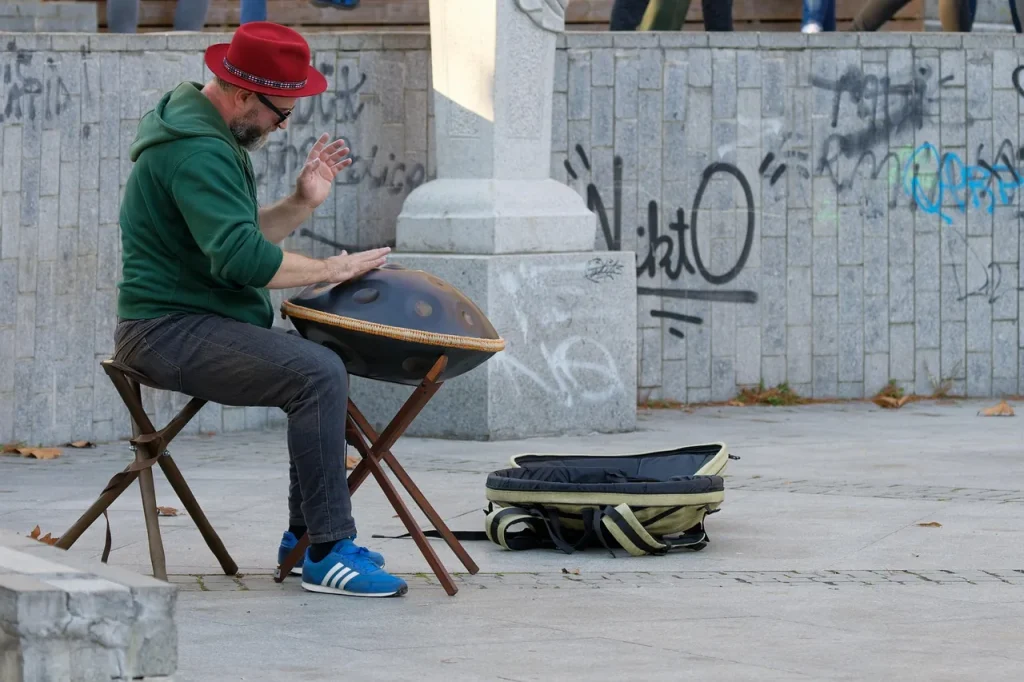
Have you always dreamed of playing a unique and melodic instrument? The handpan is an excellent choice for beginning your musical journey. This article is designed to guide you step by step, even if you have never played an instrument before.
With free resources such as video tutorials and a printable e-book, you can get started without spending any money. The visual notation system makes learning accessible to everyone, even without any prior musical knowledge.
David Charrier, an experienced teacher who has taught more than 12,000 students, is the ideal guide to help you master this instrument. With his help, you will be well on your way to creating mesmerizing melodies in no time.
Introduction to the handpan: a mesmerizing instrument
With its harmonious notes, the handpan is an ideal instrument for exploring music in a new way. Its unique, soothing sound is attracting a growing number of enthusiasts around the world.
What is a handpan?
The handpan is a nitrided-steel percussion instrument, often compared to a flying saucer. It consists of 8 to 9 notes arranged in a pentatonic scale, with a central note called the “Ding.”
Its history goes back to the Hang, an instrument developed in Switzerland in the 2000s. The modern handpan evolved to provide better sound quality and greater durability.
Why learn the handpan?
Learning to play the handpan offers many benefits. It is accessible to everyone, regardless of the model or whether it is tuned to 440 Hz or 432 Hz. It is also recognized for therapeutic benefits such as reducing stress and improving motor coordination.
One student says:
“Playing the handpan has given me an incomparable sense of well-being and a genuine connection between my body and the music.”
| Feature | Handpan | Tongue drum |
|---|---|---|
| Material | Nitrided steel | Steel or wood |
| Number of notes | 8 to 9 | 6 to 12 |
| Sound | Melodic and deep | More metallic |
Handpan basics: taking your first steps
Discover the essentials you need to get off to a good start with this melodic instrument. Whether you are a beginner or an experienced musician, mastering the first steps is crucial to making rapid progress.
How to hold and position the handpan
The ideal playing position is to place the instrument on your lap at an angle of about 30°. This posture provides better resonance and easy access to all the notes.
Left-handed players can adapt the position by slightly reversing the angle. Before beginning, warm up your hands to prevent muscle tension.
The notes and the pentatonic scale
The handpan consists of 8 to 9 notes arranged in a pentatonic scale. This structure lets you create harmonious melodies without playing wrong notes.
To identify the natural harmonics, gently strike each note and listen carefully. The central note, called the “Ding,” is the foundation of many compositions.
“The pentatonic scale offers incredible creative freedom, even for beginners.”
| Element | Description |
|---|---|
| Position | On your lap at a 30° angle |
| Scale | Pentatonic, 5 notes |
| Exercise | Warm up your hands before practicing |
To learn more about basic techniques, see this comprehensive resource.
Basic techniques for playing the handpan
Mastering the basic techniques is essential for making rapid progress. Whether you are a beginner or an experienced player, these fundamentals will help you play smoothly and accurately.

Hand and finger movements
The natural rebound of the fingers is a key part of the technique. It produces clear, harmonious sounds without excessive effort. Avoid pressing too hard on the edges of the instrument, as this can affect sound quality.
For beginners, mallets or special gloves can make practice easier. However, playing with bare hands provides a better connection with the instrument and greater sensitivity to subtle nuances.
The first rhythms to master
Begin by learning the 5 fundamental rhythmic patterns. These patterns, often paired with mnemonic devices, will help you memorize the sequences quickly.
The “clave” rhythmic structure is ideal for beginners. It provides a solid foundation for exploring more complex compositions. One student says:
“Within 30 days, I was able to master the first rhythms and create my own melodies.”
Regular practice is the key to integrating these techniques. Spend a few minutes each day repeating the movements and rhythms to achieve fast, lasting results.
Learning the handpan online: free resources
Online learning offers exceptional flexibility for mastering an instrument such as the handpan. With free resources available to everyone, you can progress at your own pace without financial constraints.
The best tutorials on YouTube
YouTube is full of beginner tutorials. Among the most highly recommended channels is David Charrier’s, which has more than 50,000 subscribers and offers clear, structured lessons. Handpan Dojo is another excellent source of practical exercises.
However, pay attention to video quality. Here are a few pitfalls to avoid:
- Poorly explained or overly technical tutorials.
- Videos without a clear structure.
- Channels that do not offer a logical progression.
Online platforms for beginners
For more structured learning, platforms such as Masterthehandpan offer comprehensive online courses. With a 14-day free trial, you can explore premium features such as the reversed immersive view.
Compared with services such as Superprof, which cost between €15 and €45 per hour, these platforms often provide better value for money. One user says:
“Thanks to the printable e-book, I was able to make rapid progress and create my first melodies.”
To learn more about the available resources, see this comprehensive guide.
Practicing the handpan: tips for improving
Improving on an instrument such as the handpan requires a structured approach and suitable advice. Whether you are a beginner or already play at a good level, regular practice and thoughtful tips will make all the difference.

Creating a practice routine
To maximize your progress, choose short but frequent sessions. For example, three 15-minute sessions each day are more effective than one hour of intensive practice. This micro-session method helps you stay focused and avoid fatigue.
Here are some quick exercises to include in your routine:
- Warm up your hands to prevent tension.
- Repeat basic rhythmic patterns.
- Explore natural harmonics.
A progress-tracking tool, such as a journal or an app, can motivate you and help you measure your development.
Common mistakes to avoid
One of the most common mistakes is neglecting instrument maintenance. A poorly maintained handpan can lose sound quality. Use an anti-resonance mat to reduce unwanted vibrations and protect your instrument.
Another pitfall is incorrect posture. Record yourself playing to identify and correct positioning problems. Finally, be wary of lessons that are not suitable for low-quality handpans, as they may slow your progress.
“Regular practice for a few minutes each day can significantly improve your skills.”
To learn more about practical tips, see this comprehensive resource.
Exploring the handpan’s musical possibilities
The handpan opens up endless possibilities for musical creativity. Whether you want to compose simple melodies or improvise freely, this instrument provides a rich and varied sound palette. Discover how to harness its potential to create unique works.

Creating simple melodies
Composing with the handpan is accessible, even without musical experience. Here is a four-step method for creating your first melody:
- Begin by exploring the basic notes and their resonance.
- Use silences as rhythmic elements to structure your composition.
- Experiment with simple patterns such as the pentatonic scale.
- Record your ideas so you can gradually refine them.
One student says:
“By following these steps, I composed a melody for a short film in just two weeks.”
Improvising with the handpan
Improvisation is one of the handpan’s strengths. The “call and response” technique, popularized by David Charrier, is an excellent starting point. It involves answering one musical phrase with another, thereby creating a dialogue in sound.
To enrich your improvisation, explore Arabic musical modes. Combined with the handpan’s pentatonic structure, these scales offer unique, mesmerizing sounds.
| Technique | Benefits |
|---|---|
| Call and response | Encourages creativity and interaction |
| Arabic modes | Add an exotic dimension to the music |
Finally, remember the importance of microphone placement when recording. Position it about 30 cm from the instrument to capture a balanced sound.
Community and sharing: meeting other players
The handpan community is a space for conversation and discovery. Whether you are a beginner or an experienced player, sharing your passion with others can enrich your practice and open up new musical perspectives.

Joining online groups and forums
Online platforms are ideal for meeting other players. For example, the “Handpan France” Facebook group has more than 12,000 members. These spaces let people ask questions, share tips, and organize meetups.
Here are some benefits of these groups:
- Access to practical advice from experienced players.
- Opportunities to participate in virtual or local events.
- The chance to find a mentor to guide your first steps.
One member says:
“Through a forum, I met another player with whom I collaborated on a musical project. It was an incredible experience!”
Taking part in workshops and events
In-person workshops and events are an excellent way to improve. The French Handpan Festival, for example, brings together more than 500 participants every year. These gatherings provide opportunities to discover new techniques and create lasting connections.
Here are a few tips for choosing the right event:
- Check the organizer’s reputation to avoid scams.
- Consult the 2024 regional meetup calendar.
- Take part in jam sessions to practice in a group.
To learn more about events and available resources, see this comprehensive guide.
| Type of event | Benefits |
|---|---|
| Workshops | Practical, interactive learning |
| Festivals | Meeting players from around the world |
| Jam sessions | Improvisation and collaborative creation |
Conclusion: your musical journey with the handpan
Your musical journey begins here with an instrument that has a unique sound. Three pillars are essential to success: regular practice, suitable resources, and a supportive community. Whether you choose free or paid learning, every choice is a step toward mastery.
Did you know that 70% of beginners persevere and achieve their goals? With a comprehensive guide and tools such as the starter kit, you are on the right track. One former beginner says: “Thanks to practice and the available resources, I became a professional in less than a year.”
Ready to begin? Download your free kit and join a passionate community. To learn more, see this comprehensive guide and embark on this musical adventure.