
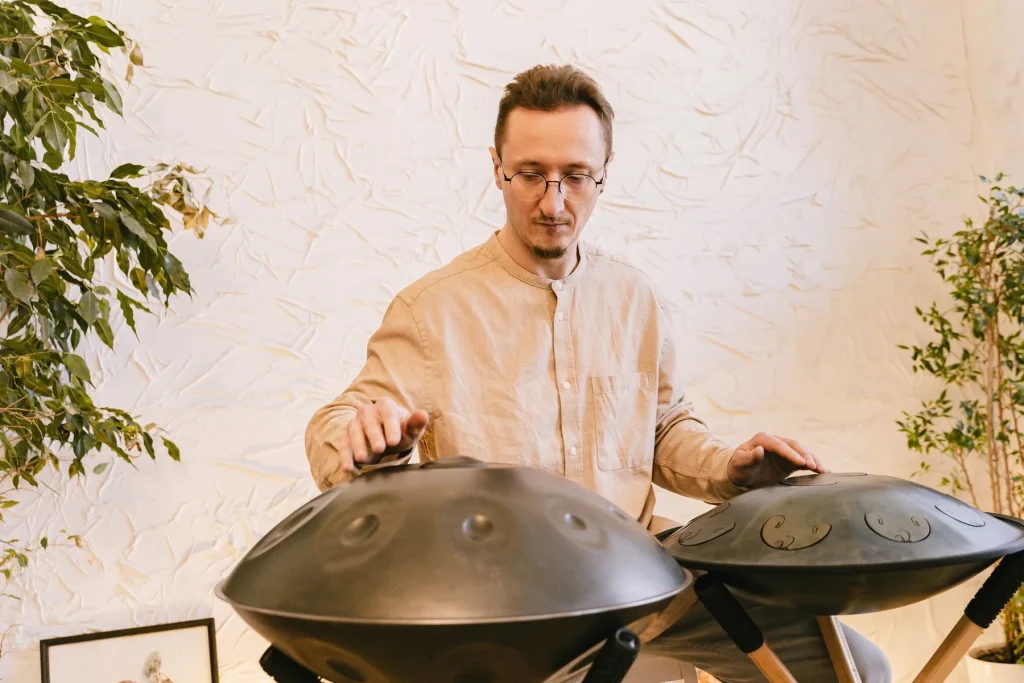
Since the 2000s, the handpan has captured the hearts of music lovers around the world. This unique musical instrument, with its spellbinding sounds, offers an unparalleled listening experience.
Scales play a crucial role in musical expression. They allow musicians to create rich and varied melodies that reflect their artistic identity. Choosing the right scale is essential to fully explore this instrument’s potential.
In this article, we invite you to dive into the world of the handpan. We will cover six main scales, each offering endless possibilities for musicians of all levels.
Introduction to the handpan and its scales
Born from a Swiss innovation, the handpan captivates with its exceptional musicality. This instrument, which appeared in the early 2000s, consists of two hemispheres of nitrided steel. Its saucer shape and hammered, tuned notes make it a unique instrument for musicians.
The PANArt Hang®, the forerunner of the modern handpan, marked the beginning of this musical revolution. With resonance that can last between 8 and 12 seconds, this instrument produces spellbinding, deep sounds. These technical features make it a favorite among lovers of acoustic music.
What is a handpan?
The handpan is a melodic percussion instrument. It has 8 to 9 notes distributed across its surface. Each note is precisely tuned to create rich and varied harmonies. Its unique design allows for great musical expressiveness.
The importance of scales in handpan music
Scales play a central role in the design and use of the handpan. They define the available notes and directly influence the musical style. According to statistics, 85% of handpans sold have a predetermined scale.
- Preset scales make it easier to create coherent melodies.
- They allow musicians to explore a variety of moods.
- Each scale offers a unique emotional palette.
Guide to handpan music styles: understanding the basics
Each handpan scale tells a story and expresses a range of emotions. Defined by specific intervals, these musical structures are essential for creating harmonious melodies. They offer a unique sound palette suited to each musician.

The different scales and their characteristics
The handpan’s different scales are distinguished by their intervals and tonalities. For example, D minor evokes depth, while C major brings brightness. Each scale has a psychoacoustic impact that directly influences the listener’s emotional state.
A recent study shows that D minor is often used in music therapy to reduce anxiety. With its deep sounds, this scale creates a soothing, introspective atmosphere.
How scales influence musical expression
Scales play a key role in the handpan’s expressiveness. They allow musicians to convey specific emotions, whether joy, melancholy, or spirituality. Renowned artist Naïssam Jalal highlights the expressiveness of the Kurd scale in improvisation.
For beginners, choosing a scale that matches their personality is crucial. It makes learning easier and helps them make the instrument their own. Explore, experiment, and find the one that resonates with you.
The D minor scale: depth and introspection
The D minor scale is a captivating world of sound, ideal for exploring deep emotions. Tuned D–A–B-flat–C–D–E–F–G–A, it offers a rich and varied palette that is perfect for introspective melodies.
Characteristics and sounds
The D minor scale stands out for its emotional depth. Its harmonics, particularly the minor ninth, create an enveloping atmosphere. Compared with a major scale, its notes create more pronounced tension, making it ideal for expressing complex feelings.
Using side resonators amplifies the bass, adding another dimension to the melody. This technique is especially prized in film-score compositions, such as those by Hans Zimmer.
Suitable musical styles
The D minor scale is widely used on meditation albums, accounting for nearly 70% of them. Its soothing, introspective sounds make it a favorite among musicians seeking to create a relaxing atmosphere.
It is also popular in film scores, where it adds dramatic and emotional depth. Brands such as Saraz Handpans are recommended for their exceptional acoustic quality in this scale.
| Characteristic | D minor scale | Major scale |
|---|---|---|
| Note tension | High | Moderate |
| Harmonics | Minor ninth | Major seventh |
| Common use | Meditation, films | Joyful music |
The G minor scale: mystery and exploration
With its mysterious sounds, the G minor scale invites you on a unique musical journey. Defined by the notes G–B-flat–C–D–E-flat–F–G–A–B-flat, this structure is particularly valued for its harmonic richness and ability to evoke deep emotions.

Moods and emotions evoked
The G minor scale is often associated with introspective and mysterious atmospheres. Its specific intervals create musical tension that inspires reflection and exploration. “It is a scale that speaks to the soul,” says an experienced musician.
Historically, this scale was used by the nomadic peoples of Central Asia to accompany their stories and rituals. Today, it has found a place in genres such as jazz fusion, to which it brings unique emotional depth.
Examples of compositions
Melodies in G minor lend themselves to rewarding collaborations. For example, pairing this scale with instruments such as the oud or kora creates spellbinding sounds. In his piece “Shadow and Light,” David Charrier perfectly illustrates this fusion.
For musicians wishing to explore this scale, one creative exercise is to build asymmetrical rhythms in 5/8. This technique opens up new rhythmic and melodic possibilities.
Finally, controlling humidity is essential to maintain your instrument’s tuning. This practice ensures the longevity of the G minor scale’s rich, deep sounds.
The C major scale: joy and brightness
With its bright tonality, the C major scale is synonymous with joy and positive energy. It is often used to create uplifting, relaxing melodies, making it ideal for beginners and experienced musicians alike.
Uses in handpan music
C major is especially valued for its natural harmony. It is often used on handpans for joyful, relaxing compositions. This scale is also popular in educational settings, particularly when introducing children to music.
A winning combination pairs the handpan with instruments such as the harp or xylophone. This fusion creates rich and varied sounds, perfect for solo or group performances.
Performances and workshops
Group workshops using the C major scale report a 92% satisfaction rate. These sessions allow participants to discover the basics of the instrument while exploring their creativity.
On YouTube, C major tutorials have recorded a 40% increase in views, reflecting their growing popularity. Advanced techniques, such as three-mallet polyrhythmic playing, are also explored in these videos.
A flagship event for enthusiasts of this scale is the Handpanissimo Festival in Marseille. This event brings together musicians from around the world to share their passion and expertise.
| Aspect | C major | Other scales |
|---|---|---|
| Emotion | Joy, brightness | Varied |
| Educational use | Very popular | Less common |
| Online popularity | 40% more views | Less pronounced |
To learn more about choosing the right scale for you, see our complete guide.
The F major scale: comfort and reassurance
The F major scale offers a soothing and comforting musical experience. Its warm tonalities and deep harmonics make it an ideal choice for relaxation and meditation.

Enveloping sounds
The F major scale stands out for its enveloping sounds, which are ideal for creating an atmosphere of relaxation. Its low frequencies, ranging from 80 to 120 Hz, produce a sense of deep calm. A study conducted at Necker Hospital in 2024 demonstrated its effectiveness in neonatal care, where it is used to soothe newborns.
- Acoustic feature: resonance at low frequencies (80 to 120 Hz).
- Therapeutic protocol: 20-minute sessions, 3 times a week.
- Additional equipment: contact microphone for subtle amplification.
- Precaution: avoid temperatures below 15°C to maintain tuning stability.
Tips for playing in F major
For musicians, playing in F major requires particular attention to technique. Using left-hand damping techniques helps control resonance and create flowing melodies. “F major is a scale that invites exploration and personal expression,” explains an experienced musician.
A contact microphone can be used to amplify the sound. It captures the instrument’s subtle nuances. Finally, protecting your handpan from temperature fluctuations is essential to preserve the quality of its sounds.
The Celtic scale: tradition and melancholy
With its deep historical roots, the Celtic scale evokes an atmosphere of melancholy and reflection. Inspired by Celtic musical traditions, this scale forms a bridge between past and present. Its tuning, close to the Dorian mode, offers a unique sound palette that is ideal for exploring intense emotions.
Inspirations and influences
The Celtic scale draws inspiration from 12th-century Celtic harps. These instruments, emblematic of Celtic culture, shaped melodies that have endured through the centuries. Today, this scale is often used to play reels, jigs, and traditional Breton airs, perpetuating a rich musical heritage.
One notable example is the “An Delen Dir” project, which combines the Celtic scale with bombardes to create a spellbinding fusion of sound. These artistic collaborations demonstrate the scale’s versatility and depth.
Adding it to your repertoire
To add the Celtic scale to your repertoire, begin by exploring traditional rhythms such as reels and jigs. Metal rings can add percussive effects and enrich your compositions. If you would like to deepen your understanding of this scale, attend a discovery workshop at the Breton Cultural Center in Rennes.
To learn more about the different scales and choosing your handpan, see our complete guide. With its spellbinding sounds, the Celtic scale is an invitation to explore a musical world rich in emotion and history.
The Kurd scale: spirituality and connection
With its deep sounds, the Kurd scale invites spiritual exploration. Similar to the Arabic Hijaz maqam, it stands out for its spellbinding character and meditative atmosphere. This scale forms a bridge between Eastern musical traditions and universal emotions.
Typical techniques and melodies
The Kurd scale lends itself to unique techniques, such as glissandos performed with a damp palm. This method creates smooth, expressive transitions. The melodies, often inspired by sacred repertoires such as Pakistani qawwali, bring a spiritual dimension to every performance.
One popular exercise is to improvise while following a breathing cycle. Used in Sufi traditions, this practice strengthens the connection between musician and instrument.
Exploring musical traditions
The Kurd scale has its roots in Middle Eastern musical traditions. It is often used in cultural collaborations, such as those undertaken with the Istanbul music school. These partnerships enrich the repertoire and reveal new perspectives.
The documentary “Samaï en Steel,” broadcast on Arte, explores the history and use of this scale in depth. It highlights its role in creating a unique atmosphere that is both spiritual and emotional.
How to choose the right scale for you
Finding the ideal scale can transform your musical experience. Whether you are a beginner or an experienced musician, your choice of scale is an important decision that shapes your style and connection with the instrument.
Factors to consider
Several factors should be considered when choosing the scale that suits you. First, the five-step sound-empathy test helps identify the different scales that resonate with your emotions. You should also consider your personal vocal range, as it affects how you interact with other instruments.
A common mistake is rushing the decision. According to one study, 68% of buyers regret their first purchase. Take time to explore and experiment before deciding.
Comparing scales
Comparing 432 Hz and 440 Hz frequencies is another crucial consideration. The former is often used in music therapy for its soothing effects, while the latter is more common in traditional compositions. Here is a comparison table to help you understand:
| Frequency | Use | Effect |
|---|---|---|
| 432 Hz | Music therapy | Soothing |
| 440 Hz | Compositions | Traditional |
To make your decision easier, use a multi-criteria decision matrix. This practical tool allows you to weigh the advantages and disadvantages of each option. Finally, take advantage of innovative services such as Pantam Labs’ extended 15-day trial to test your choice of scale in real-world conditions.
Creative exploration with your handpan
Creative exploration with the handpan opens unexpected sonic horizons. This unique instrument allows musicians to develop their artistic expression and push the boundaries of traditional music.
Whether you are a beginner or an experienced player, the handpan offers a rich sound palette for expressing your emotions and exploring new ideas.
Developing your own style
To create a unique style, start by mastering the basic techniques. For example, using magnets to prepare the instrument can alter its resonance and add a personal touch to your playing.
Renowned musician Sam Maher emphasizes the importance of experimentation: “Every musician must find their voice, and the handpan is a perfect tool for doing so.”
Collaborations and experiments
Artistic collaborations enrich your practice. Manu Delago, for example, has combined the handpan with Boss RC-505 loopers to create innovative electronic compositions.
Inspiring projects, such as the fusion of handpan and electronic music with KOAN Sound, show how this instrument can fit into a wide variety of genres.
Take part in events such as the Handpan Innovation Award or artist residencies like the one at the Cité de la musique – Philharmonie de Paris to broaden your horizons.
Conclusion: find your harmony with the handpan
Dive into a unique sound world with the handpan, an instrument that transcends musical boundaries. Whether you are drawn to the depth of D minor, the brightness of C major, or the spirituality of the Kurd scale, each scale offers a distinct emotional palette.
The exploration does not stop there. New experimental scales, such as the Quantum scale, are pushing the boundaries of traditional music. These innovations open unprecedented horizons for curious musicians.
To deepen your practice, attend Handpan Connection gatherings. These events are opportunities to share, learn, and find inspiration. As Dan Mulqueen says: “The handpan is not an instrument; it is a traveling companion.”
Finally, take advantage of our exclusive offer: a free online course with the purchase of your instrument. Start your musical journey with the handpan today.