

Led Zeppelin is an iconic British band founded in 1968 by the talented Jimmy Page. The band revolutionized the world of rock by infusing it with new energy and unprecedented sonic power. The name Led Zeppelin came from a joke by Keith Moon, who predicted that Page’s project would go down like a “lead zeppelin.” To avoid any confusion in the United States, the “a” was removed.
With more than 300 million albums sold worldwide, Led Zeppelin remains an essential reference, even more than forty years after breaking up. This article explains how four exceptional musicians absorbed influences from blues, folk, and rock to create a wholly original body of work.
Rolling Stone magazine even described the band as “the heaviest band of all time” and “the biggest band of the seventies.” The founding members—Jimmy Page on guitar, Robert Plant on vocals, John Paul Jones on bass and keyboards, and John Bonham on drums—defined their era.
By the late 1960s, the musical landscape was undergoing profound change. The sound was becoming harder, heralding the rise of hard rock and heavy metal. This article delves into the musical creativity and unique chemistry of this legendary band.
Introduction: the Led Zeppelin phenomenon and its impact on rock
The band redefined musical standards in the 1960s and 1970s. Led Zeppelin was far more than just a band: it was a genuine musical earthquake. At a time when the musical landscape was changing rapidly, it established a heavy, ambitious sound that moved beyond traditional blues rock.
Its impact on music history is undeniable. In 1995, the Rock and Roll Hall of Fame noted that its influence during the 1970s was comparable to that of the Beatles in the previous decade. Led Zeppelin left its mark on generations of musicians and fans around the world.
Its commercial success is equally impressive. More than 300 million albums were sold worldwide, including over 112 million in the United States. This makes it one of the best-selling bands in music history.
The longevity of its music is remarkable. It continues to influence contemporary artists and reach new audiences. This proves that its reinvention of rock-and-roll classics was visionary.
Despite a relatively short twelve-year career, Led Zeppelin produced a rich and cohesive body of work. To understand the band is to grasp how classic rock was transcended through the unique chemistry of four extraordinary individuals.
| Year | Albums sold (millions) | Cultural impact |
|---|---|---|
| 1968 | 0.5 | Formation of the band |
| 1970 | 5 | Emergence on the music scene |
| 1975 | 100 | Worldwide recognition |
| 1980 | 300 | Enduring legacy |
The band’s origins: a landmark lineup on the 1960s rock scene
In the late 1960s, a group of talented musicians was preparing to redefine the musical landscape. Jimmy Page, an exceptional guitarist, played a key role in creating the project. In the early 1960s, he became one of London’s most sought-after session guitarists. His career began at age 14, when he appeared on a BBC talent show.
In 1966, Page joined the Yardbirds alongside Jeff Beck. In 1968, however, the remaining members left the band, leaving Page alone at the helm. At that point, John Paul Jones, a talented bassist and arranger, contacted him. Together, they planned to form a new band that would make history.
Jimmy Page and the birth of the project
Determined to realize his musical vision, Page began recruiting members. He first considered Steve Marriott and then Terry Reid, who turned down the offer. Reid then recommended Robert Plant, a young singer with a powerful voice. Excited by the idea, Plant quickly agreed to join the venture.
The decisive recruits: Robert Plant, John Paul Jones, and John Bonham
The lineup was completed with the arrival of John Bonham, an exceptional drummer whom Plant knew from their time together in the Band of Joy. Page and manager Peter Grant bombarded Bonham with telegrams to persuade him to join the band, despite interest from Joe Cocker. Their first rehearsal took place around August 19, 1968, in a room on Gerrard Street in London. The four musicians tried the classic Train Kept A-Rollin’ and discovered an instant chemistry.
Choosing the name Led Zeppelin and its symbolic implications
The band’s name, Led Zeppelin, grew out of an incident in 1966. Keith Moon, drummer for the Who, had joked that Page’s project would go down like a “lead zeppelin.” To prevent confusion over its pronunciation in the United States, the “a” was removed. The first concert under this name took place on November 9, 1968, at the London Roundhouse in Chalk Farm, marking the beginning of an adventure that would revolutionize the music world.
Manager Peter Grant also played a crucial role by signing a five-year contract with Atlantic Records and securing a $200,000 advance, a considerable sum for a band that was still unknown at the time.
| Member | Role | Contributions |
|---|---|---|
| Jimmy Page | Guitarist | Creation of iconic riffs and musical direction |
| Robert Plant | Singer | Powerful voice and stage presence |
| John Paul Jones | Bassist | Musical arrangements and mastery of keyboards |
| John Bonham | Drummer | Energetic rhythm and impressive technique |
Led Zeppelin’s adoption and transformation of traditional rock and roll
Led Zeppelin’s impact on the musical landscape is undeniable, with an approach that fused several genres. Its music drew primarily on blues, folk, and rock, but did not stop there. The band also incorporated elements of rockabilly, reggae, soul, funk, and jazz, as well as classical and Celtic influences.
The roots of its unique sonic universe ran deep into traditional American blues. The band drew inspiration from legends such as Muddy Waters, Howlin’ Wolf, Leadbelly, and Robert Johnson. These influences laid the foundations for a powerful, distinctive sound.
The blues, folk, and rock roots of their music
British and Celtic folk played a decisive role in Led Zeppelin’s music. Jimmy Page’s acoustic arrangements incorporated elements of medieval music and traditional English ballads. This enriched the band’s repertoire and gave it an added dimension.
How the band revisited and fused these styles
Led Zeppelin did not merely reproduce these influences. The band radically transformed them by amplifying and electrifying them. This new energy defined the emerging hard-rock genre. John Paul Jones, through his extensive knowledge of classical music and jazz, also enriched the band’s sonic palette.
This ability to absorb and transcend traditional rock-and-roll classics lay at the heart of its artistic approach. Songs such as Train Kept A-Rollin’ were reinvented and took on an epic, hypnotic dimension.
The band also incorporated more unexpected influences, such as reggae and soul. This musical cross-pollination created a richness that was exceptional for its time. Every influence was absorbed and reinterpreted in service of Led Zeppelin’s artistic vision.
This approach allowed the band to create an instantly recognizable sound. It influenced generations of musicians and redefined the boundaries of rock for years to come.
| Influences | Key artists | Musical elements |
|---|---|---|
| Blues | Muddy Waters, Robert Johnson | Powerful riffs, song structures |
| Folk | Celtic traditions | Acoustic arrangements, ballads |
| Rock | Yardbirds | Electric energy, improvisation |
| Other genres | Reggae, funk | Varied melodies, innovative rhythms |
Led Zeppelin’s innovative musical style: a fusion of power and lyricism
The band made music history through a bold and original approach. Its unique style blended raw power with lyrical delicacy, creating an unforgettable listening experience.
Jimmy Page’s guitar riffs and unique sounds
As guitarist and producer, Jimmy Page revolutionized the band’s sound. He is famous for iconic guitar riffs such as those in Whole Lotta Love and Black Dog. Through his innovative use of recording techniques, he created soundscapes of extraordinary richness.
Page mainly used a Gibson Les Paul, as well as a Gibson EDS-1275 double-neck guitar, notably on Stairway to Heaven. These instrumental choices helped create a distinctive sound that remains etched in listeners’ memories.
John Bonham’s iconic drumming: rhythm and power
With his Ludwig Vistalite drum kit, John Bonham established a new standard for rock drumming. His relentless groove and unmatched power made him a legendary drummer. Every song benefited from his innate sense of rhythm and dazzling fills, which allowed the music to breathe.
Robert Plant’s powerful, evocative vocal melodies
Robert Plant, the band’s singer, possessed a stratospheric voice capable of shifting from a primal howl to a spellbinding whisper. This ability brought a lyrical and mystical dimension to Led Zeppelin’s compositions. His stage performances were often electrifying and captivated audiences at every concert.
John Paul Jones’s understated but fundamental role
Although often underestimated, John Paul Jones played an essential role as bassist and keyboardist. He was the band’s true musical architect, contributing sophisticated arrangements and mastery of several instruments. His contribution gave Led Zeppelin’s music remarkable depth and harmonic complexity.
The combination of these four exceptional talents created unique chemistry. Together, they moved from a torrent of sound to an acoustic ballad with astonishing fluidity. On stage, their songs could stretch beyond thirty minutes through collective improvisations that became the band’s hallmark.
Each musician contributed his own color and energy, creating a perfect balance between instinct and technical mastery. This fusion of power and lyricism defined Led Zeppelin’s innovative musical style and placed the band at the pinnacle of the music scene.

The debut album: a revolution recorded in 36 hours
Recorded in just 36 hours, the band’s self-titled debut album was released on January 12, 1969. The record captured the raw energy of a concert and was strongly influenced by 1950s blues and folk. It featured hard-hitting riffs and powerful vocals, establishing a new standard in the world of music.
Analysis of landmark songs such as “Good Times Bad Times”
The opening track, Good Times Bad Times, perfectly illustrates John Bonham’s talent on drums, coupled with John Paul Jones’s virtuosity on bass. Jimmy Page’s incisive riff sets the tone for a bold, uncompromising album. From the opening seconds, listeners are immersed in a captivating sonic universe.
Another standout track is Dazed and Confused, a musical journey that would become a concert staple, with improvisations sometimes exceeding thirty minutes. Communication Breakdown erupts like punk before its time, foreshadowing the rise of hard rock.
Critical and public reception
Jimmy Page’s visionary production work turned the studio into an instrument in its own right. His microphone-placement techniques and innovative use of effects enabled him to sculpt unprecedented sounds. The crucial role of manager Peter Grant must also be emphasized. He negotiated a historic contract with Atlantic Records, securing a $200,000 advance for a band that was still completely unknown.
Despite initially divided reviews, the album was an immediate success. Less than four months after the band’s first concert, it laid the foundations of what would become its hallmark: powerful riffs, spellbinding vocals, and a relentless rhythm section. This debut record was a manifesto announcing the musical revolution to come and is now regarded as one of the first hard-rock albums in history.
| Elements | Details |
|---|---|
| Release date | January 12, 1969 |
| Recording time | 36 hours |
| Influences | Blues, folk |
| Key tracks | Good Times Bad Times, Dazed and Confused, Communication Breakdown |
| Atlantic Records contract | $200,000 |
The band’s rise: Led Zeppelin II and III
The band’s career reached a decisive turning point with the release of its second album. Led Zeppelin II, released on October 22, 1969, was recorded largely during the American tour. The album propelled the band into the ranks of the decade’s biggest record sellers and earned it the nickname “The Brown Bomber” in the United States.
The record asserted the band’s identity in hard rock and blues rock. Songs such as Whole Lotta Love perfectly illustrate this growing power. The song’s hypnotic riff and experimental middle section became instant classics of the genre.
The American tour accompanying the album was triumphant. Audiences were won over by Jimmy Page’s showstopping solos and the collective improvisations, which could extend some songs beyond thirty minutes. These spectacular performances even led some bands to refuse to take the stage after them, confirming Led Zeppelin’s status as an essential musical phenomenon.
On October 5, 1970, Led Zeppelin III was released, marking a major artistic turning point. The album demonstrated that the band was about more than furious guitar riffs and Robert Plant’s aggressive vocals. Half its songs were intimate ballads, revealing a more nuanced and subtle side of the group.
This artistic evolution was inspired by the Welsh countryside, where Page and Plant retreated to compose. Although it baffled part of the public and the critics, it demonstrated the band’s determination never to repeat itself and to keep exploring new musical territory.
This growing commercial and artistic strength laid the groundwork for the peak of its career with the forthcoming fourth album.
The fourth album: the artistic and commercial pinnacle
The fourth album, released on November 8, 1971, is considered the masterpiece of this iconic band. The record, whose cover bore neither a title nor the band’s name, became one of the best-selling albums in music history.
Literary and esoteric influences permeate the album. Robert Plant‘s lyrics were inspired by J. R. R. Tolkien’s The Lord of the Rings. In addition, Jimmy Page displayed a fascination with occultism, particularly the figure of Aleister Crowley.
Cult classics, including “Stairway to Heaven”
Among the album’s centerpieces, Stairway to Heaven stands out. The song develops from a gentle acoustic arpeggio into a legendary guitar solo. Its complexity, rich lyrics, and emotional power make it a timeless rock anthem.
Other songs, such as Black Dog, with its hypnotic riff, and Rock and Roll, which pays tribute to the genre’s pioneers, also illustrate the album’s musical diversity. When the Levee Breaks stands out for its monumental drum sound, which became one of the most sampled in music history.
The bold decision not to display the band’s name on the cover strengthened its mystical aura. Each member chose a mysterious symbol to represent him, defying the conventions of the record industry.
Jimmy Page‘s exceptional production work also deserves emphasis. He spent hours in the studio sculpting every sound and texture. The result was an album of unmatched sonic richness that became a benchmark for musicians and sound engineers.
This fourth album marked the culmination of the fusion between power and lyricism. It moved fluidly between songs of unprecedented sonic violence and ballads of exquisite delicacy. More than fifty years after its release, it is still considered one of the greatest records in rock history.
Led Zeppelin: how they reinvented classic rock and roll
The band revolutionized the musical landscape by breathing new energy into classic songs. Its bold approach transformed traditional rock into an unprecedented listening experience. By incorporating a variety of elements, it created a powerful and captivating sound.
Musical innovation and a break with tradition
Led Zeppelin redefined the conventions of music by playing with compositional dynamics. The band alternated between passages of extreme violence and moments of airy gentleness. This mastery of contrast produced songs of unparalleled intensity.
Adapting classics with a rawer, more hypnotic energy
By adapting blues and rock standards, the band created sonic odysseys. Its version of Dazed and Confused could last more than thirty minutes, transforming every concert into a unique experience. This sonic and rhythmic amplification renewed interest in these classics.
The importance of concert improvisation in this constant renewal
Concert improvisation was a hallmark of the band. Every performance became an exceptional communion with the audience. This approach, inherited from jazz, kept Led Zeppelin’s music from ever becoming fixed and allowed the band to reinvent it continually on stage.
Ultimately, this ability to reinvent its music, whether in the studio or on tour, made Led Zeppelin unique in rock history. Its influence continues to be felt decades after its breakup.

Led Zeppelin’s power on stage: legendary, unforgettable concerts
The stage was always the band’s favorite playground. Led Zeppelin’s concerts became legendary, captivating thousands of fans around the world. Each performance was a unique experience combining sonic power and charisma.
The American tours played a crucial role in its ascent. During its first U.S. tour, the band stole the spotlight from established acts. Initially booked to open for Vanilla Fudge and Iron Butterfly, Led Zeppelin quickly moved to center stage and established itself as one of the greatest bands of the era.
The importance of the American and European tours
The 1977 American tour is often considered the largest the band ever undertook. With more than fifty concerts, it was intended to prove that Led Zeppelin remained at the top despite the emergence of new bands. This triumphant return made a powerful impression and consolidated its status as a rock giant.
Key performances: Royal Albert Hall, Madison Square Garden, Knebworth
The 1970 concert at the Royal Albert Hall was a high point in its career. Captured in a documentary, it showed the band at its peak. The performance remains one of the most iconic in rock history.
In 1973, the Madison Square Garden concert was immortalized in the film The Song Remains the Same. The film captured the essence of the band’s power on stage and its feverish improvisations. Every show was an adventure in which the musicians allowed themselves to be carried by the audience’s energy.
The Knebworth festivals of August 1979 also made a lasting impression. Led Zeppelin played before audiences of 218,000 and then 187,000, setting an unmatched attendance record. This return after several years away was a resounding triumph.
The band’s stage power rested on the unique chemistry among its members. Jimmy Page, John Bonham, Robert Plant, and John Paul Jones created an explosive dynamic together. They launched into collective improvisations lasting more than thirty minutes, making every concert unique and unpredictable.
Led Zeppelin’s concerts were true sensory experiences. The sonic power, lighting effects, and Robert Plant’s charismatic presence created an intense communion with the audience. These performances helped forge the band’s legend and became benchmarks for every musician aspiring to genuine stage presence.
| Event | Date | Audience (estimated) | Location |
|---|---|---|---|
| First concert | November 9, 1968 | Unknown | London |
| Royal Albert Hall | 1970 | Unknown | London |
| Madison Square Garden | 1973 | Unknown | New York |
| Knebworth Festival | August 4 and 11, 1979 | 218,000 / 187,000 | Knebworth |
The role of management and production: Peter Grant and Swan Song Records
As manager, Peter Grant significantly shaped the band’s musical identity. His imposing presence revolutionized the profession and enabled Led Zeppelin to secure unprecedented contractual terms. He always fiercely protected the band’s interests.
Grant negotiated a historic contract with Ahmet Ertegün of Atlantic Records. The deal, which included a $200,000 advance, was exceptional for a still-unknown band. He also insisted that the band retain complete artistic control over its music, an extremely rare clause at the time.
As part of his strategy to conquer the American market, Grant decided that the band would not release singles. Instead, he chose to sell complete albums. This approach, which ran counter to record-industry practices, strengthened the band’s cult status.
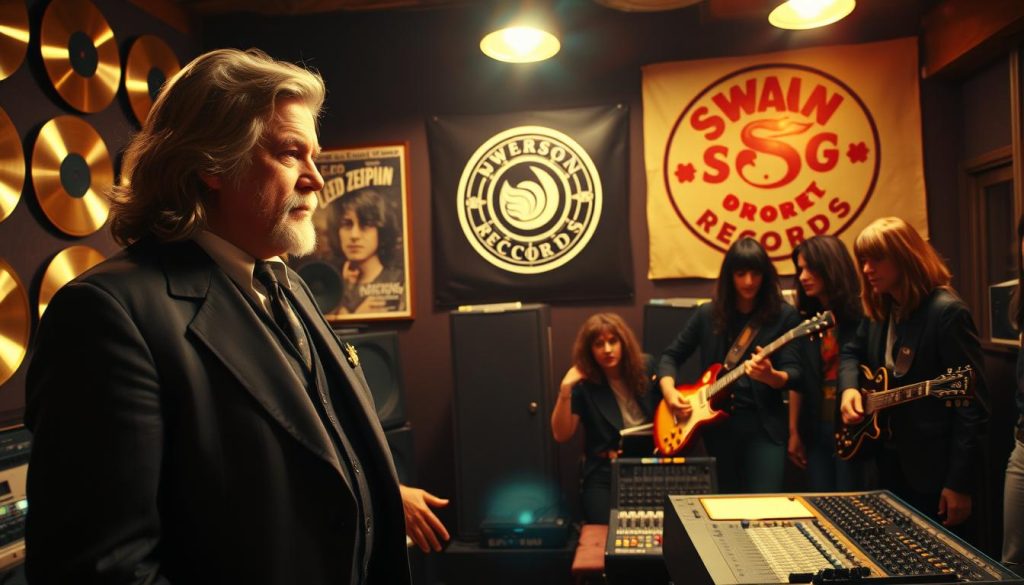
In 1974, at the end of its contract with Atlantic, the band created its own label, Swan Song Records. This gave it complete independence and allowed it to produce other artists while maintaining control over its entire musical output.
Swan Song Records also helped finance the first Monty Python film, Monty Python and the Holy Grail, illustrating the eclecticism and open-mindedness of the band and its management.
Jimmy Page‘s visionary production work was essential. He personally handled this role on every album, refusing to work with an outside producer. This enabled him to retain absolute control over the sound and artistic direction.
This fierce independence, both contractual and artistic, was one of the keys to Led Zeppelin’s success. It encouraged many bands to demand complete control over their music.
Peter Grant’s management and the creation of Swan Song Records allowed the band to navigate the music industry by its own rules. This preserved its artistic integrity while enabling it to reach unmatched commercial heights.
Excess, mysticism, and legend: the band’s symbolic dimensions
The excess and mysticism surrounding this iconic band helped forge a fascinating legend. One of the most intriguing aspects was Jimmy Page‘s fascination with occultism. He was an ardent admirer of Aleister Crowley, even purchasing Crowley’s former residence, Boleskine House, on the shore of Loch Ness in Scotland. The house became a symbol of his interest in the esoteric philosophies that influenced the band’s aesthetic.
Each member chose a mysterious symbol for the fourth album, adding an enigmatic dimension to the band’s image. Page’s symbol, known as Zoso, fueled endless speculation about its esoteric meaning.
The band’s notorious reputation
Over the years, Led Zeppelin acquired a notorious reputation, fueled by accounts of wrecked hotel rooms, decadent parties, groupies, and drug abuse. These stories helped create a dark legend around the band that captivated the public imagination.
The rumors and anecdotes circulating about the band, whether true or not, helped build Led Zeppelin‘s mysterious and dangerous aura. Some lyrics, such as those of No Quarter or The Battle of Evermore, explore legendary and mystical themes, reinforcing this symbolic dimension.
However, this fascination with the occult and notorious reputation sometimes obscured the reality of the band’s hard work and professionalism in the studio. There was thus a gap between the legend and the reality of its music.
These symbolic aspects, whether real or amplified by rumor, are an integral part of the mythology of Led Zeppelin. They helped forge its cult status, blending reality and fiction, musical genius and excess. The legend continues to fascinate fans and music historians decades after the band’s breakup.
Difficult times: injuries, personal tragedies, and internal tensions
Personal ordeals profoundly affected the dynamics of this legendary band. On August 4, 1975, Robert Plant and his wife Maureen were involved in a serious car accident on the island of Rhodes. The accident left the singer confined to a wheelchair for many months, jeopardizing the band’s future.
Plant’s recovery period was particularly difficult. He wondered whether he would ever walk again. Meanwhile, the band had to adapt to this delicate situation while recording the album Presence under unusual circumstances in early 1976.
Another tragedy struck the band on July 26, 1977. Robert Plant learned of the death of his youngest son, Karac, who was only six years old. The tragedy abruptly ended the American tour and plunged the singer into profound grief.
Addiction also had a significant impact on the band’s creativity. Beginning in 1976, Jimmy Page started using heroin, which gradually affected his ability to play and his presence in the studio. These dependency problems created internal tensions within the band. Page lost weight and fell out of sync with the other members during concerts, harming the quality of the live performances.
During the recording of In Through The Out Door in 1978, Page’s influence was weaker than that of John Paul Jones because of his repeated absences. This gave the album a different musical character, with a stronger emphasis on keyboards.
Despite these ordeals, the band found the strength to continue. It produced significant albums such as Presence and In Through The Out Door, demonstrating remarkable resilience in the face of adversity. Far from being incidental, these difficult moments were an integral part of Led Zeppelin‘s history and profoundly affected the band’s music and dynamics during its final years.

The dramatic end: John Bonham’s death and the band’s dissolution
The final chapter in the band’s story was written on September 25, 1980, with the loss of its iconic drummer. That day, after drinking forty shots of vodka in four hours, John Bonham choked in his sleep at Jimmy Page’s home in Bray. He was staying there for rehearsals for the forthcoming American tour.
Bonham’s sudden death caused an immense shock for the band members, musicians, and the entire rock world. John Bonham was considered one of the most talented and influential drummers in history. His death left an immeasurable void in the hearts of his bandmates.
Faced with this tragedy, the three surviving members made a unanimous and immediate decision: they would not continue without him. They believed his drumming was an essential and irreplaceable component of the band. Continuing without Bonham would have betrayed his musical legacy.
The 17-date American tour, which was to mark the band’s grand return to North American stages, was canceled. The comeback was highly anticipated, three years after the previous tour had been abruptly interrupted. The band had also just completed a 14-date European tour between June 17 and July 7, 1980, intended as the prelude to a new phase in its career.
John Bonham’s death ended twelve years of an exceptional musical adventure. The band revolutionized the musical landscape and produced some of the most influential albums in music history. Although painful for fans, the decision not to continue without Bonham reflected the band’s artistic integrity and the members’ profound mutual respect.
This dramatic ending contributed to the band’s legend, forever frozen at the height of its glory. It never experienced the artistic decline that often affects bands continuing beyond their era.
| Date | Event | Impact |
|---|---|---|
| September 25, 1980 | Death of John Bonham | End of Led Zeppelin |
| June 17–July 7, 1980 | European tour | Final tour |
| Cancellation of the American tour | 17 scheduled dates | Aborted comeback |
Attempts and rare reunions after the breakup
The members of this legendary band attempted to reunite on stage several times after their breakup. Each reunion was highly emotional and rekindled the flame of their music.
Special concerts: Live Aid, Hall of Fame, O2 Arena
The first reunion took place at the historic Live Aid benefit concert in 1985. Accompanied by Phil Collins and Tony Thompson on drums, the surviving members delivered a memorable performance. Despite some technical problems, the concert marked an emotional return to the stage.
In 1988, to celebrate Atlantic Records’ 40th anniversary, John’s son Jason Bonham took his father’s place on drums. This moment of symbolic succession deeply moved fans and strengthened the bond between generations.
The concert at London’s O2 Arena on December 10, 2007, was undoubtedly the most significant reunion. With Jason Bonham on drums, the show attracted 20 million ticket requests for only 20,000 available seats, setting a world record. The performance was immortalized in the film Celebration Day, allowing fans to relive this unique moment.
The remaining members’ solo projects
Outside these reunions, the remaining members pursued rewarding musical careers. Jimmy Page and Robert Plant collaborated in the 1980s with The Honeydrippers, and then in the 1990s as Page and Plant, producing albums such as No Quarter and Walking into Clarksdale.
John Paul Jones, meanwhile, continued his career as a musician, arranger, and producer, collaborating with various artists. Despite many requests from fans for a full reunion, Robert Plant consistently refused to return to the stage with the band, preferring to devote himself to his own musical projects.
These rare reunions, although brief, kept the flame of this iconic band alive and passed its musical legacy on to new generations of fans.
Led Zeppelin today: legacy and influence on modern music
The British band left an indelible mark on modern music, with more than 300 million albums sold. It is regarded as a pioneer of hard rock and heavy metal alongside bands such as Black Sabbath and Deep Purple. Its influence extends across generations of musicians, from Guns N’ Roses to Metallica.
Beyond hard rock, its influence extends to other musical genres. Its powerful riffs and samples of John Bonham‘s drumming are among the most widely used in music history. They can be found in genres as varied as alternative rock, hip-hop, and even electronic music.
The enduring appeal of its music is remarkable. The band’s albums continue to sell in the millions every year, reaching new audiences decades after their release. This demonstrates the timelessness of its work.
Its music is also ubiquitous in films, television series, and advertising. This helps maintain its presence in contemporary popular culture. Its mythical status remains intact, making it a reference point for musicians around the world.
The myth of Led Zeppelin is passed down from generation to generation. Young people discover its music with the same fascination as their parents or grandparents. Its legacy is not limited to its music; it also encompasses its revolutionary approach to the music industry.
By refusing to release singles and retaining complete artistic control, the band redefined industry standards. More than forty years after its breakup, it remains one of the most influential and revered bands in rock history. Its music continues to resonate with undiminished power across the decades.
Conclusion: Led Zeppelin’s enduring legacy and its reinvention of classic rock and roll
With a career marked by unmatched success, the band captivated millions of fans around the world. Its enduring legacy rests on a bold reinvention of rock, infused with new energy and unparalleled sonic power.
The unique chemistry among Jimmy Page, Robert Plant, John Paul Jones, and John Bonham produced a body of work that transcends eras. More than 300 million albums sold attest to their impact, as do their legendary tours.
The band’s reinvention of rock did not come through rejection, but through transforming the roots of blues and folk. Its revolutionary approach to the music industry inspired generations of artists, consolidating its status as an absolute benchmark.
The band’s legend will endure, while its music will continue to touch the hearts of future generations. Rock as Led Zeppelin redefined it embodies values of instinct, emotion, and rebellion, which the band itself expressed with unmatched intensity.