
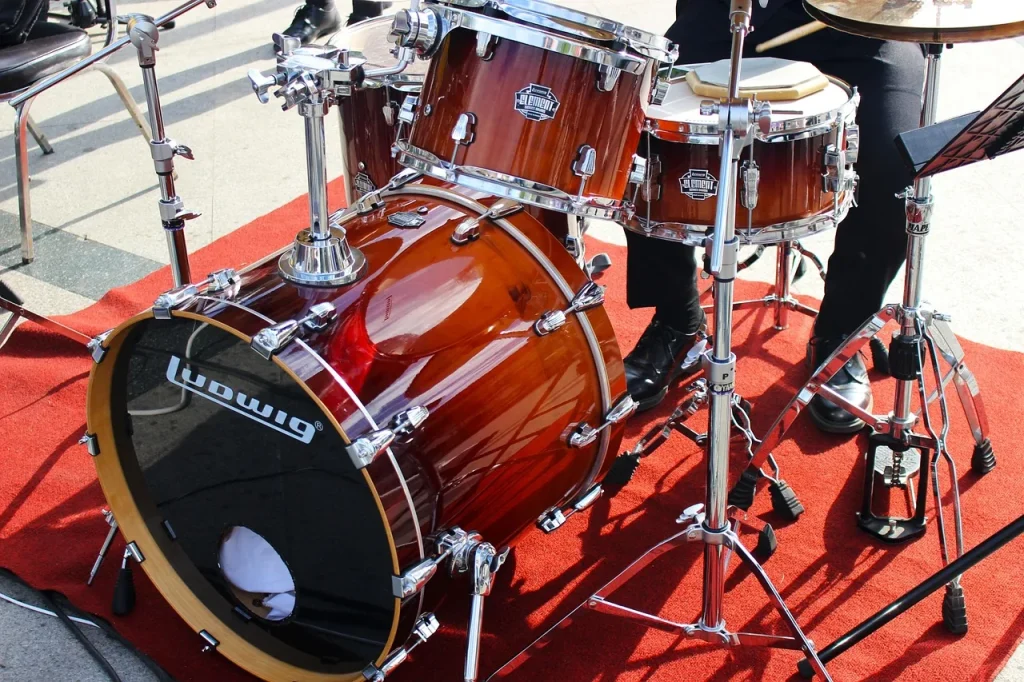
John Bonham is often considered the greatest drummer in rock history. His impact on music is immeasurable. According to Rolling Stone magazine, he ranks among the greatest. His unique technique and power redefined drumming.
This iconic musician transcended generations. His playing influenced generations of drummers and became an essential benchmark. With Led Zeppelin, he shaped a sound that left its mark on the world of music.
In this article, we will explore his journey, from his humble beginnings in Redditch to his timeless legacy. We will also discuss his iconic equipment and innovative techniques. John Bonham was also a complex man, powerful behind the drums but vulnerable in life.
Get ready to enter the fascinating world of a musician who changed drumming forever.
1. John Bonham’s Biography and Early Years
The fascinating journey of a future musician began in Redditch. Born on May 31, 1948, he grew up in a modest family. His father, a carpenter, ran a small business, while his mother operated a newsagent and tobacconist’s shop.
From the age of five, young Bonham turned everyday objects into percussion instruments. He struck kitchen utensils, tubs, and bath-salt containers. This early creativity foreshadowed a passion for the drums that would never leave him.
At the age of ten, his mother gave him his first snare drum. This gift marked the beginning of his devotion to music. At fifteen, his father gave him his first real drum kit, a basic Premier set. It allowed him to play seriously and develop his technique.
John Bonham was a self-taught drummer. He never took lessons and learned by listening to records. He reproduced rhythms by ear and absorbed the swing of jazz big bands. Seeing Gene Krupa on television had a profound effect on him, as did his admiration for Buddy Rich and Ginger Baker.
Social conditions in Redditch were not easy. An unenthusiastic student, he left school early to join his father on construction sites. Despite this, he dreamed of becoming a professional drummer. In 1965, he married Pat Phillips, whom he had met at a concert. The couple moved into a caravan, and their son Jason was born in July 1966.
Balancing nights spent playing in local bands with construction work was challenging. He lost his job in the family business and had to take on a series of odd jobs. This struggle for survival did not diminish his passion for the drums.
2. John Bonham’s Arrival in Led Zeppelin and the Emergence of a Unique Style
The summer of 1968 marked a decisive turning point for rock music. At that time, Jimmy Page, after leaving the Yardbirds, decided to form a new band. He first recruited bassist John Paul Jones, followed by singer Robert Plant. Convinced of his friend’s talent, Plant immediately recommended John Bonham as the drummer.
The first rehearsals of the New Yardbirds, soon to become Led Zeppelin, revealed an impressive chemistry. John Paul Jones and John Bonham formed a solid, complementary rhythm section. This synergy would be essential to the development of the band’s unique sound.
2.1. Meeting Robert Plant and Jimmy Page
The meeting between Robert Plant and John Bonham in the band Crawling King Snakes in 1966 proved decisive. Their musical and personal rapport would be crucial to their subsequent careers. Their friendship grew stronger as they shared the stage and the same musical aspirations.
2.2. The Band’s Early Days and First Tours
The first American tour began in December 1968. Although British audiences and the media were initially indifferent, the situation quickly changed. Thanks to a contract Peter Grant secured with Atlantic Records, the band began to make a name for itself.
For this first tour, Bonham played a Slingerland kit loaned by the Yardbirds’ drummer. This kit was later replaced by Ludwig drums, which would become his signature.
2.3. Establishing His Style on the Early Albums
In March 1969, Led Zeppelin’s self-titled debut album was released. Recorded and mixed in just thirty hours, it immediately established the band’s sound. Bonham’s phenomenal power became a central element of Led Zeppelin’s musical identity.
By October 1969, Led Zeppelin II had reached number one on the charts in the United States and England. The band was named “Band of the Year 1969,” marking the beginning of a meteoric rise.
Across the albums, Bonham’s unique style became firmly established. His massive bass drum, rapid triplets, and relentless groove became hallmarks of this iconic band’s sound.

3. John Bonham’s Equipment: An Iconic, Powerful Sound
The equipment used by this artist played a crucial role in defining his unique sound. Over the years, he refined his setup to achieve unmatched power and clarity. Every element of his kit was carefully chosen to meet his artistic needs.
3.1. Discovering and Adopting Ludwig Drums
During the first American tour in December 1968, Carmine Appice, the drummer for Vanilla Fudge, helped him gain access to Ludwig drums. Thanks to him, a complete kit including two bass drums was sent over. However, Jimmy Page soon asked for the second bass drum to be removed because Bonham’s volume was so powerful that the band could hear nothing else.
3.2. The Iconic Kit: Sizes and Configurations
This artist’s iconic kit included:
- Bass drum: 26″ x 14″, delivering a deep, massive sound.
- Mounted tom: 14″ x 10″, replaced by a 15″ x 12″ between 1977 and 1979 for greater tonal presence.
- Floor toms: 16″ x 16″ and 18″ x 16″, adding unparalleled depth.
- Snare drum: 14″ x 6.5″ Ludwig Supraphonic LM402, renowned for its bright attack.
3.3. Choice of Cymbals, Drumsticks, and Drumheads
All of his chosen cymbals were made by Paiste:
- Hi-hats: 15″ Paiste 2002 Sound Edge
- Crash cymbals: 18″ and 20″
- Ride cymbal: 24″ Paiste 2002
His drumsticks were the longest and heaviest available, earning them the nickname “trees.” They enabled him to produce colossal volume. In the studio, he used coated Remo Emperor drumheads, while onstage he opted for clear heads.
3.4. The Evolution of His Kits Across Led Zeppelin’s Different Eras
Several kits defined different periods of his career:
- Natural Maple: 1968–1970, for warm resonance.
- Green Sparkle: 1970–1973, accompanying the iconic albums.
- Vistalite Amber: 1973–1975, immortalized in the film The Song Remains The Same.
- Stainless Steel: 1977–1980, for the final tours.
These kits not only evolved over time but also helped shape the band’s iconic sound. This artist’s equipment remains a benchmark for many musicians today.
4. John Bonham: The Style, Technique, and Groove of Led Zeppelin’s Drummer
This artist’s music is a true fusion of genres. He brilliantly combined the swing of jazz drummers, the groove of funk, and the raw power of rock. This unique blend shaped his approach and enabled him to leave his mark on music history.
4.1. A Fusion of Jazz Swing, Funk Groove, and Rock Power
As Steve Smith observed, his playing was a perfect synthesis. He embodied the swing of Gene Krupa and Buddy Rich while incorporating elements of the funk played by Al Jackson and James Brown’s drummers. This musical diversity enabled the artist to create a distinctive sound.
The famous right-foot bass-drum triplet heard in the opening bars of “Good Times Bad Times” became his technical signature. This rhythmic pattern is now a benchmark for many drummers seeking to reproduce it.
4.2. Signature Techniques: Right-Foot Triplets, Bare-Handed Playing, and Solos
His striking technique relied primarily on his wrists. This enabled him to produce colossal volume while maintaining remarkable speed and precision. Neil Peart even said that he knew how to make the instrument “sing.”
Bare-handed playing, inspired by Joe Morello, was incorporated into his famous solo “Moby Dick.” During this solo, while the other band members left the stage, he could play for up to thirty minutes. He alternated between drumsticks and his bare hands, using various instruments such as toms, congas, and even a gong.
4.3. Sense of Tempo, Improvisation, and Dynamics
This artist’s sense of tempo was unique. He played with a relaxed groove, sitting slightly behind the beat. This gave his rhythms a heavy, swinging feel that was especially noticeable on songs such as “The Lemon Song” and “Fool in the Rain.”
His improvisational ability was legendary. He refused to play the same solo at every concert, saying that doing so would be “deadly boring.” He could therefore improvise for more than thirty minutes and create an unforgettable musical experience.
The dynamics of his playing shifted between massive rhythms and more restrained passages. In this way, he left room for the other musicians, demonstrating a musical sensitivity that went far beyond sheer power. He constantly explored new percussion instruments, seeking to enrich his sonic palette.
5. John Bonham’s Influence and Legacy in the World of Drumming
His influence on drumming is so profound that it continues to inspire generations. He redefined the standards of drumming, and his impact can be felt across every musical genre. Modern drummers from both rock and jazz acknowledge his legacy.
Dave Grohl, drummer for Nirvana and Foo Fighters, said:
“John Bonham played the drums like someone who didn’t know what was going to happen next, as though he were staggering along the edge of a cliff. No one has ever come close to that since.”
Roger Taylor of Queen considers him the greatest rock drummer of all time. His ability to create an enormous sound with a single kit was remarkable. Jimi Hendrix, meanwhile, said that he had “a right foot like castanets,” emphasizing the speed of his playing.
Charlie Watts of the Rolling Stones also expressed his admiration, saying that nobody was better at what he did. Through his recordings, he remains present in musicians’ minds.
The “Bonham sound” has become an absolute benchmark. Here are some key aspects of his legacy:
- Colossal impact: His style redefined the standards of rock drumming and continues to inspire musicians from every background.
- Techniques he popularized: His approach to the bass drum, triplets, and relaxed groove influenced many modern drummers.
- Legendary equipment: Reissues of his gear, such as the Vistalite Zep Set, allow new generations to get closer to his legendary sound.
- Musical reach: His influence extends far beyond rock, reaching funk, jazz, and metal drummers.
- Recognition: Drummers such as Red Hot Chili Peppers’ Chad Smith emphasize that his sound came above all from his hands and soul.
6. Anecdotes and the Human Side of John Bonham
This man’s life reveals a striking contrast between his strength onstage and his fragility. As a drummer, he made the walls of the world’s largest stadiums shake. In his personal life, however, he was sensitive and deeply attached to his family.
6.1. Power and Fragility: The Paradox
His reputation as a loud character developed early in his career. He played so hard that he was banned from performing in more than thirty English clubs. The managers could no longer tolerate seeing him break through drumheads.
Despite this power, he remained vulnerable. His sensitivity kept him close to his loved ones, and he longed for a simple life away from the spotlight.
6.2. Memorable Anecdotes and Tour Antics
His tour antics became legendary. His excessive alcohol consumption and altercations often made headlines. He constantly sought thrills, as illustrated by his passion for sports cars.
In the film The Song Remains The Same, he is seen driving a dragster at nearly 380 km/h, a metaphor for his boundary-pushing personality.
6.3. Family Life and Personal Challenges
Life on tour with the band moved at a frantic pace. Travel by private jet and exclusive use of entire hotels could not conceal either the boredom or the loneliness. These feelings fueled his anxieties.
To cope with his fear of flying, he turned to alcohol, which led to excesses. His family life was his refuge, where he found serenity with his wife Pat and their children, Jason and Zoë.
On June 17, 1980, during a concert in Nuremberg, he collapsed over his drum kit after only three songs. This extreme exhaustion was a tragic warning that went unheeded before rehearsals resumed for a new American tour.
On September 25, 1980, he was found dead, the victim of pulmonary edema. His funeral took place on October 10, 1980, in Rushock. A few weeks later, the band announced the end of its journey, refusing to continue without its rhythmic heart.
7. Conclusion
This artist’s career is a fascinating journey. From his early days in Redditch, where he played on pots and pans, to his rise as one of the greatest drummers in rock history, his story is inspiring. His contribution to the band’s sound was essential. Without his powerful groove and rhythmic creativity, the band would not have reached the heights that enabled it to make history.
His technical legacy endures and influences generations of drummers around the world. Bass-drum triplets and the use of uniquely sized kits are techniques that continue to inspire. Beyond technique, it was his musical soul that made the difference. He knew how to make his playing serve the band, alternating between power and subtlety.
Finally, we must not forget the man behind the legend. This artist was generous and devoted to his family, but he was also vulnerable to the excesses of success. To rediscover his genius, simply listen to his songs with the band, such as “Good Times Bad Times” or “Fool in the Rain.” More than forty years after his death, his name still resonates as an essential reference in the world of drumming.