
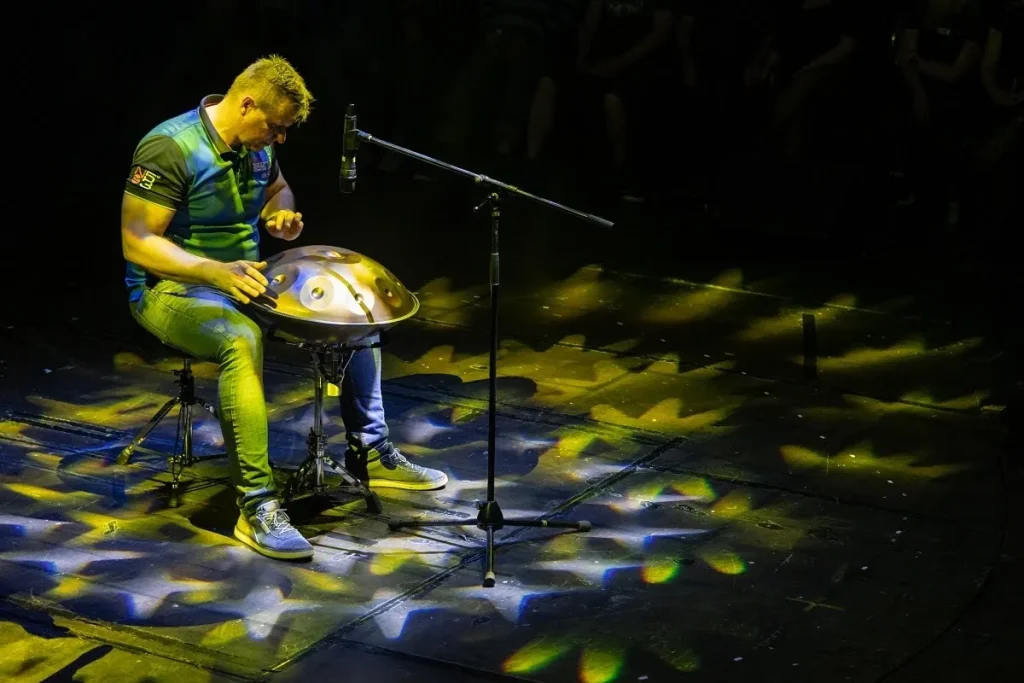
The handpan is a unique instrument that requires technical mastery to reveal all its melodic and harmonic richness. Experienced musicians face many challenges, but these open the way to deeper artistic expression.
Precision of touch and suitable posture are essential to make full use of this instrument’s potential. Without methodical work, 70% of players reach a plateau, highlighting the importance of rigorous practice.
Progress involves several areas: hand independence, mastery of special effects and a better understanding of nuances. These elements provide greater creative freedom and make it possible to create varied compositions.
To learn more about methods for progressing, consult this comprehensive guide.
Introduction to advanced handpan mastery
Moving from beginner to experienced level on the handpan requires a methodical approach and close attention to detail. Rich in harmonics, this instrument requires precision of touch to realize its full potential.
The difference between beginner and experienced playing lies in the mastery of advanced techniques. While beginners focus on the fundamentals, experienced players explore nuances such as harmonics and percussive effects.
Three key components are essential: precision of touch, harmonic awareness and dynamic control. These elements make it possible to create fluid, expressive melodies.
Active listening plays a central role in continual improvement. Recording your sessions and using a metronome are effective self-assessment methods for measuring your progress.
Thierry Bleton, a renowned musician, emphasizes the importance of a solid technical foundation:
“Without rigorous practice, it is difficult to progress to a higher level.”
To deepen your knowledge, discover how to improve your playing technique.
Optimizing posture and instrument position
Posture and the way you hold the handpan directly affect sound quality and player comfort. A good position provides easier access to the notes and helps prevent muscle tension.
Ergonomic positions
There are three main positions for playing the handpan: seated, standing and on a stand. Each offers specific advantages depending on the musician’s needs.
| Position | Advantages | Disadvantages |
|---|---|---|
| Seated | Maximum stability, ideal for long sessions | Limits body movement |
| Standing | Freedom of movement, suitable for dynamic performances | May cause fatigue |
| On a stand | Greater comfort, allowing you to focus on playing | Requires additional equipment |
Handpan orientation for easy access to the notes
The handpan’s angle of inclination is crucial for easy access to the notes. An angle of between 15° and 30° is recommended to optimize resonance and striking accuracy.
Here is a five-step process for adjusting its orientation:
- Position the instrument at waist height.
- Tilt it slightly toward you.
- Check your access to the low and high notes.
- Adjust the angle for maximum comfort.
- Test the resonance by playing a few notes.
Exercises for finding your personal balance
To improve your posture, try proprioceptive exercises. For example, hold a standing position for three minutes while focusing on your balance.
These exercises help develop body awareness, which is essential for fluid, expressive playing. Adapt them to your body shape and preferences.
Advanced striking and resonance techniques
Exploring the subtleties of striking and resonance reveals a new palette of sounds. These methods require close attention to finger pressure, speed and release.

Precise touch: pressure, speed and release
Mastering precise touch depends on three key elements: pressure, speed and release. Too much pressure can deaden the sound, while too little reduces resonance.
Here is a table comparing the pressure required for each type of note:
| Note type | Pressure (g/cm²) |
|---|---|
| Low | 50-70 |
| Midrange | 30-50 |
| High | 20-30 |
The controlled rebound technique is ideal for rapid sequences. It involves quickly releasing your fingers after each strike to maximize fluidity.
Mastering harmonics and muted notes
Harmonics add another dimension to your playing. To isolate them, use a sideways strike at a 45° angle.
Here is a progressive four-stage exercise for mastering fifth and seventh harmonics:
- Lightly strike the edge of the note.
- Gradually increase your striking speed.
- Experiment with different angles.
- Incorporate the harmonics into a melody.
Muted notes are also essential for creating sonic contrasts. Produce them by gently placing your fingers on the note after striking it.
Percussive techniques: slap, tap and metallic effects
Percussive techniques such as the slap and tap add rhythmic texture to your playing. A dry slap produces a clear sound, while a resonant slap provides a deeper tone.
Spectrographic analysis reveals the differences between these two types of slap. The dry slap has a sharper attack, while the resonant slap provides longer resonance.
The musician Kabeçao often uses metallic effects in his compositions. Produced with rapid, light strikes, these effects create a unique atmosphere.
Developing hand independence and coordination
To reach a higher level on this instrument, hand independence and coordination are essential. These skills allow you to play complex rhythms and enrich your compositions.
Polyrhythm and syncopation exercises
Polyrhythms are an excellent way to develop hand independence. For example, try playing a 3/4 rhythm with your left hand and a 4/4 rhythm with your right.
Here is a table comparing rhythmic patterns in 7/8:
| Pattern | Left hand | Right hand |
|---|---|---|
| 1 | 2-2-3 | 3-2-2 |
| 2 | 3-2-2 | 2-3-2 |
| 3 | 2-3-2 | 2-2-3 |
Use a metronome with variable subdivisions to practice. Start slowly, then gradually increase the speed.
Crossed patterns for enriching compositions
Crossed patterns add depth to your compositions. For example, alternate between low and high notes to create a dynamic effect.
Here is an exercise for developing this technique:
- Play a low note with your left hand.
- Follow it with a high note played by your right hand.
- Repeat with the hands reversed.
- Experiment with different intervals.
Contrapuntal playing: simultaneous melody and accompaniment
Contrapuntal playing involves performing a melody while providing accompaniment with the other hand. This technique requires intense concentration and excellent coordination.
One practical example is an adaptation of the pattern from David Kuckhermann’s “Spiral Dance.” Try playing the melody with your right hand while maintaining a steady rhythm with your left.
To progress, practice exercises that separate the left and right hands while counting aloud. This strengthens your independence and accuracy.
Using special effects and sonic nuances
Sonic nuances and special effects transform your playing into an immersive experience. These techniques add depth and expressiveness to your compositions.

Glissando and vibrato for expressive transitions
A glissando involves sliding your fingers across the notes to create a smooth transition between sounds. This technique is ideal for adding a melodic touch to your playing.
Vibrato, meanwhile, adds subtle modulation to sustained notes. Try the “circular vibrato” technique to enrich your melodies.
Creative use of the Gu (bass opening)
The Gu, or bass opening, is a key element for making use of low frequencies. Combine it with body percussion to create complex, compelling rhythms.
To learn more about these techniques, consult this comprehensive guide.
Playing with dynamics (piano, forte, crescendo)
Mastering dynamics is essential for adding dimension to your music. Experiment with nuances such as piano, forte and crescendo to vary the intensity of your playing.
One effective exercise is to vary the dynamics over ascending and descending scales. This strengthens your control and expressiveness.
Improvisation and composition techniques
Improvisation and composition are essential pillars for exploring the handpan’s musical richness. These approaches allow you to create unique melodies and express your artistic personality.

Structuring a solo: musical phrases and rests
A well-structured solo relies on a balance between musical phrases and rests. Rests are not empty spaces, but moments that give the music dimension.
Here is a typical structure for a solo:
- Introduction: 10% of the total duration.
- Development: 60% of the total duration.
- Climax: 20% of the total duration.
- Conclusion: 10% of the total duration.
Experiment with this structure to create compelling solos.
Making use of handpan-specific scales
Distinctive scales such as Hijaz Kar in D harmonic minor offer unique sonorities. These scales make it possible to create varied atmospheres and enrich your compositions.
Here is an overview of some uncommon scales:
- Hijaz Kar: ideal for Eastern melodies.
- Mixolydian: perfect for dynamic rhythms.
- Dorian: adds a melancholy touch.
Use these scales to explore new sonic dimensions.
Incorporating external elements (voice, body percussion)
Incorporating voice and body percussion adds another dimension to your playing. These elements make it possible to create rich, varied sonic textures.
One effective technique is natural overdubbing, which involves layering frequencies to enrich the music. For example, combine light strikes with whispers to achieve an immersive effect.
Manu Delago uses this technique in his piece “Bells” to create a spellbinding atmosphere. Draw inspiration from his approach to enrich your practice.
Playing in a group and blending with other instruments
Playing the handpan in a group opens up new musical possibilities. With its harmonic richness, the instrument is ideally suited to collaborations with other instruments. Whether paired with an udu, violin or guitar, the experience becomes immersive and rewarding.

Rhythmic and harmonic adaptation
Rhythmic and harmonic adaptation is essential for blending the handpan with other instruments. With an udu, a Nigerian percussion instrument, for example, the rhythms must be synchronized to create sonic cohesion. One effective exercise is to use a metronome to align the tempos.
Here is a three-step process for tuning in with diatonic instruments:
- Listen carefully to the fundamental frequencies of each instrument.
- Adjust the handpan to match the dominant keys.
- Test the harmony by playing a simple melody together.
Musical dialogue techniques for duos
Musical dialogue, such as the call-and-response technique, creates a dynamic interaction between musicians. For example, a handpan player can introduce a melodic phrase, while a violin responds with a variation. This method strengthens creativity and rapport.
One successful example is the combination of handpan and lute, as heard in Valentin Mussou’s performances. This pairing offers a unique and compelling sonic texture.
Managing sonic space in an ensemble
Managing sonic space is crucial for avoiding frequency conflicts. In concert, it is important to position each instrument in a way that optimizes resonance. One effective strategy is to use acoustic mixing techniques to balance the volume levels.
An active-listening exercise, such as partially covering the ears, helps you better understand the place of each instrument within the ensemble. This makes it possible to create balanced overall harmony.
To learn more about group playing techniques, consult this comprehensive guide.
Conclusion: toward a fulfilling artistic practice
Progress in handpan practice depends on a structured approach and continual exploration. Five essential pillars guide this development: posture, precise touch, hand independence, the use of special effects and improvisation. Each of these elements helps enrich your musical experience.
To move forward, establish a personal development plan. Set clear goals, monitor your progress and adjust your method to suit your needs. Documenting your learning with an audio journal is a valuable way to measure your progress.
Consider development opportunities such as masterclasses and international gatherings. These occasions allow you to interact with other enthusiasts and deepen your mastery.
Finally, join specialist communities to share your passion and continue progressing. Practicing the handpan is a rewarding journey in which every step brings you closer to fulfilling artistic expression.