
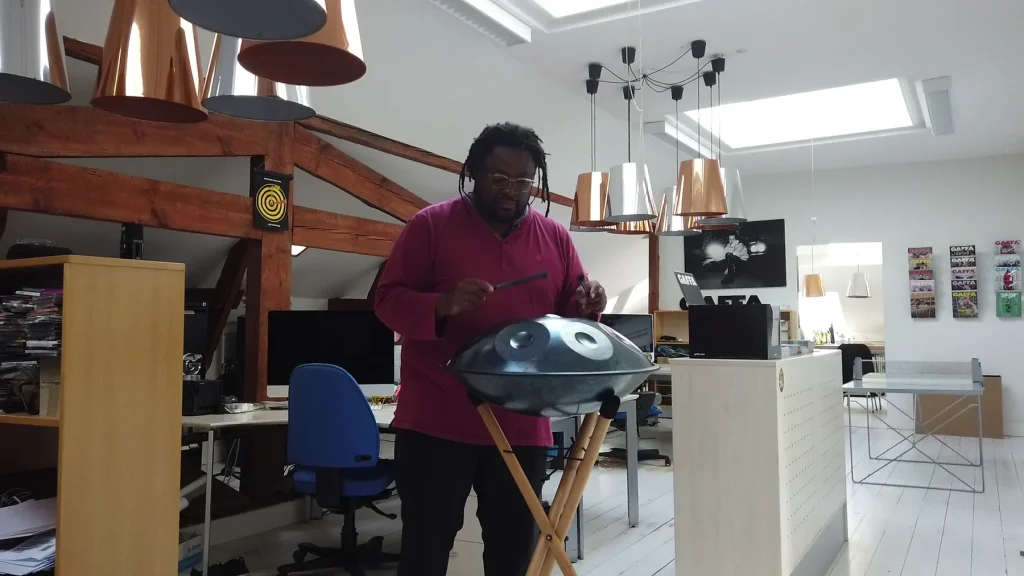
The handpan is a unique instrument that revolutionized the world of music in the 21st century. Created in Switzerland by Felix Rohner and Sabina Schärer in 2000, it combines a variety of cultural influences, including the Indian ghatam and Caribbean steel drums.
This instrument is the result of a fusion between ancestral craftsmanship and technological innovation. Between 2001 and 2005, more than 5,000 Hangs, the first version of the handpan, were produced. Today, there are approximately 300 artisanal makers around the world.
The handpan has also found a place in fields such as therapeutic music and meditative practices. To learn more about its benefits, see this resource.
Introduction to the handpan: a captivating instrument
With its unique design, the handpan offers an unprecedented musical experience. Made from two tuned steel hemispheres, this instrument stands out for its simplicity and rich sound. Eight to nine notes are arranged in a circle around a central “ding,” providing a predetermined scale without wrong notes.
The handpan’s sound-production mechanism is unique. Vibrations from the steel membranes, amplified by a resonating chamber, create harmonious, soothing sounds. This acoustic quality makes it a favored tool in music therapy and meditation.
Compared with traditional steelpans, the handpan has evolved to develop its own distinctive construction and timbre. Its ergonomics, designed for intuitive playing, allow a natural interaction between the musician and the instrument. To learn more about how it works, see this resource.
Lastly, communities of handpan players have grown exponentially. Today, more than 100 artisanal makers contribute to its popularity, making this instrument a genuine cultural phenomenon.
The origins of the handpan: a cultural fusion
Born from a rich history, the handpan combines a variety of musical traditions. This instrument is the result of a unique blend of ancestral techniques and modern innovations. Two major influences shaped its development: the Indian ghatam and Caribbean steel drums.

The influence of the Indian ghatam
The ghatam, an earthenware pot used since the eighth century, is one of the handpan’s ancestors. This traditional Indian instrument is based on vessel-percussion techniques. The ghatam’s acoustic principles were adapted to metal, giving rise to rich, harmonious tones.
The ghatam inspired the design of the handpan, particularly through its ability to produce deep, melodic sounds. This cultural influence made it possible to create a unique instrument combining tradition and modernity.
Caribbean steel drums
Steel drums, developed in Trinidad during the 1940s, also played a key role in the handpan’s evolution. These instruments were originally made from recycled oil drums. Ellie Mannette, regarded as the father of the modern steelpan, standardized their tuning.
Musical restrictions in Trinidad drove craftspeople to innovate, transforming everyday objects into melodic instruments. This creativity directly influenced the handpan’s design, particularly through the use of steel as its primary material.
| Characteristic | Ghatam | Steel drums |
|---|---|---|
| Origin | India (8th century) | Trinidad (1940s) |
| Material | Earthenware | Steel |
| Influence | Percussion techniques | Evolution of oil drums |
| Key figure | – | Ellie Mannette |
These two instruments, originating from different cultures, helped shape the handpan as we know it today. Their legacy continues to inspire craftspeople around the world.
Felix Rohner and Sabina Schärer: the creators of the Hang
In 1999, a revolutionary idea took shape thanks to Reto Weber. This Swiss musician envisioned a new instrument that would fuse tradition and innovation. Felix Rohner and Sabina Schärer, two passionate craftspeople, took up the challenge and brought the Hang to life.
In their workshop in Bern, they developed a unique creative process. Their goal was to make an intuitive instrument, played by hand and capable of producing an enchanting sound. The first prototypes presented major technical challenges, but their perseverance paid off.
The collaboration with Reto Weber
Reto Weber played a key role in the creation of the Hang. A musician and percussionist, he proposed the initial concept in 1999. His vision of a melodic, meditative instrument inspired Felix Rohner and Sabina Schärer. Together, they turned this idea into reality.
In 2001, the Hang was officially unveiled at Musikmesse Frankfurt. This event marked the beginning of its popularity. Reto Weber thus contributed to the rise of an instrument that would win over the world.
The first prototypes
The first Hang prototypes were developed with great care. Felix Rohner and Sabina Schärer experimented with 45 different sound models. Each version was the product of meticulous craftsmanship.
There were many technical challenges. Finding the right balance between design and acoustics required years of research. Their unconventional philosophy, embodied by PANArt, guided every stage of the creation process.
| Element | Details |
|---|---|
| Year designed | 1999 |
| Official presentation | Musikmesse Frankfurt, 2001 |
| Number of sound models | 45 |
| Philosophy | Noncommercial, artisanal |
PANArt also established strict selection criteria for buyers. Every Hang was handmade in Bern, Switzerland. This approach reinforced the instrument’s uniqueness and quality.
YouTube videos had a decisive impact on its popularity. They garnered millions of views, turning the Hang into a worldwide phenomenon. To learn more about its history, see this resource.
The technical evolution of the handpan
Since it first appeared, the handpan has undergone significant technical advances. Craftspeople have continually improved its acoustic and structural characteristics. These innovations have made it possible to create a more stable and harmonious instrument.

Tuning techniques
Tuning a handpan is a complex, painstaking process. It is based on specific harmonics: the fundamental, octave, and fifth. These harmonics, in a 1:2:3 ratio, ensure a rich, balanced sound.
Tuning methods may be manual or machine-assisted. Craftspeople often favor the manual approach for precise control. Machines, however, allow faster and more uniform production.
The average lifespan of a tuning is 5 to 10 years. It depends on the heat treatments applied, such as nitriding and annealing. These techniques strengthen the instrument’s acoustic stability.
Materials used
Steel is the handpan’s base material. Special alloys such as nitrided steel are favored for their strength and sound quality. These materials provide excellent resonance and a long service life.
The thickness of the metal has also evolved, increasing from 1.2 mm to 2 mm. This variation directly influences the depth and clarity of the sound. The shape of the dome also plays a key role in resonance.
Recent innovations include advanced surface treatments. These techniques improve durability and acoustic performance. They also make it possible to customize the instrument’s appearance.
| Aspect | Tuning techniques | Materials used |
|---|---|---|
| Harmonics | 1:2:3 (fundamental, octave, fifth) | Nitrided steel |
| Methods | Manual or machine-assisted | Thickness: 1.2 mm to 2 mm |
| Lifespan | 5 to 10 years | Advanced surface treatments |
These technical advances have established the handpan as a high-quality instrument. Craftspeople continue to innovate to produce ever more captivating sounds.
The handpan in modern culture
The handpan has won over the modern world through its enchanting sound and versatility. Once little known, this instrument is now a cultural phenomenon that transcends borders. Its presence can be felt on digital platforms and at international festivals alike.

Popularity on digital platforms
In 2023, handpan videos surpassed 500 million views on YouTube. This popularity can be explained by the instrument’s visual and sonic magic. Influential musicians such as David Charrier contributed to this recognition by sharing their performances and tutorials.
The market for online lessons has also boomed. Many enthusiasts can now learn to play the handpan from home. This accessibility has enabled the instrument to reach a wider audience.
Furthermore, hybrid styles such as electro-handpan have emerged, fusing tradition and modernity. These innovations show how the handpan continues to evolve and adapt to current trends.
Dedicated festivals and communities
The handpan has given rise to a passionate international community. More than 120 festivals are dedicated to it each year, including HangOut USA and the Pantheon Steel Gathering. These events bring together thousands of enthusiasts and professionals.
Platforms such as Handpan.org allow players to connect, exchange advice, and share their love of the instrument. These communities play a key role in spreading handpan culture.
In Switzerland, the birthplace of the instrument, the handpan has even influenced music tourism. Visitors come from around the world to discover its history and take part in workshops. To learn more about the benefits of this instrument, see this resource.
Legal challenges and competition
The handpan’s growing popularity has generated legal issues and increased competition. Since its invention, this instrument has been the subject of intellectual-property disputes and a proliferation of independent makers. These challenges have shaped the market’s evolution while raising questions about product quality and authenticity.
Intellectual-property disputes
PANArt, which originally created the Hang, had to protect its invention against unauthorized copies. In 2009, a landmark lawsuit pitted PANArt against Ayasa, a Dutch maker. The dispute highlighted the limits of patent protection in the musical field.
PANArt’s strategies included strict criteria for buyers and a noncommercial philosophy. However, these restrictions sometimes hampered innovation and limited access to the instrument. Certifications such as the Hang Quality Standard were introduced to guarantee a certain level of quality.
The emergence of new craftspeople
Despite the legal challenges, the handpan market has boomed. In 2023, there were more than 300 independent makers around the world. This 400% growth since 2015 reflects the enthusiasm surrounding this unique instrument.
Brands such as Spacedrum have emerged, offering more accessible options. However, this competition has also led to higher prices, which have risen from €800 to an average of €3,500. Craftspeople must now balance innovation with respect for tradition.
Complete guide to the origins of the handpan: a summary
From 1999 to 2023, the handpan underwent a spectacular transformation. Born in Switzerland, this instrument evolved into a worldwide phenomenon. Its history has been marked by technical innovations and growing popularity.

The timeline of its development includes several key milestones. In 1999, Felix Rohner and Sabina Schärer created the first prototype. In 2001, the Hang was presented at Musikmesse Frankfurt, marking its arrival on the international stage.
Between 2005 and 2010, demand soared, leading to the emergence of new craftspeople. Today, more than 300 makers produce handpans around the world. This growth reflects the enthusiasm for this unique instrument.
| Generation | Characteristics | Year |
|---|---|---|
| Hang 1 | Initial prototype, limited sound | 1999 |
| Hang 2 | Improved acoustics, ergonomic design | 2001 |
| Hang 3 | Stabilized tuning, advanced materials | 2005 |
| Hang 4 | Customization, surface treatments | 2010 |
Current trends show a diversification of styles and uses. The handpan is now present in therapeutic music, meditation, and even international festivals. Its sociocultural impact is undeniable.
Projections for 2030 anticipate continued market growth. With the rise of digital platforms and online communities, the handpan is expected to reach an even wider audience. This instrument, which arose from humble origins, continues to inspire and fascinate.
The art of choosing a handpan
Choosing a handpan is a crucial step for any musician, whether a beginner or an experienced player. This unique instrument offers a variety of sounds and scales, making the selection process all the more important. To make the right choice, it is essential to understand the available options and consider your personal needs.
Available musical scales
The handpan stands out for its many musical scales, each offering a unique sonic atmosphere. The most popular include:
- Kurd: a melodic, soothing scale that is ideal for meditation.
- Hijaz: inspired by Middle Eastern music, it adds an exotic touch.
- Equinox: a versatile scale suited to various musical styles.
According to the Institute of Modern Instrument Making, there are more than 50 different scales, each suited to specific preferences and uses. Take the time to listen to several models to find the one that resonates with you.
Advice for beginners
If you are starting out with the handpan, here are a few tips to guide you:
- Weight and ergonomics: make sure the instrument is comfortable to play.
- Tuning: choose a simple scale to make learning easier.
- Budget: entry-level models are perfect for a first purchase.
Avoid common mistakes such as choosing an overly complex model or neglecting ergonomic tests. Recommended brands for beginners include Spacedrum and Pantheon Steel, which offer quality instruments at accessible prices.
Conclusion: the legacy of the handpan
Over the years, this instrument has revolutionized the world of music. Its technical innovations, such as the evolution of materials and scales, have redefined its use and reach. Today, it is used in more than 70 countries, in fields ranging from relaxation to meditation.
The outlook for the future is promising, with the integration of new technologies such as AI for tuning. These advances could improve the precision and customization of its sounds. However, preserving the artisanal expertise that forged its unique identity remains essential.
To learn more about the origins of the handpan, explore its rich history and cultural impact. This instrument continues to inspire and fascinate while adapting to modern trends.